- Job Seeker Statistics
- Career Change statistics
- Internship Statistics
- Job Search Statistics
- Average Number Of Jobs Applied
- Average Salary Increase When Changing Jobs
- Part Time Job Statistics
- Age Discrimination Statistics
- Networking Statistics
- Interview Statistics
- Average Number of Jobs In A Lifetime
- Resume Statistics
- Side Hustle Statistics
- Teacher Statistics
Internship Research Summary. Internships are a crucial gateway to securing employment after graduation in almost every sector across the United States. As businesses increasingly seek candidates with internship experience, we aimed to uncover the latest benefits and trends surrounding internships. Our data analysis team has summarized the following key insights:
-
Approximately 300,000 individuals undertake internships annually in the United States.
-
70% of interns are offered full-time positions at the same organization where they completed their internship.
-
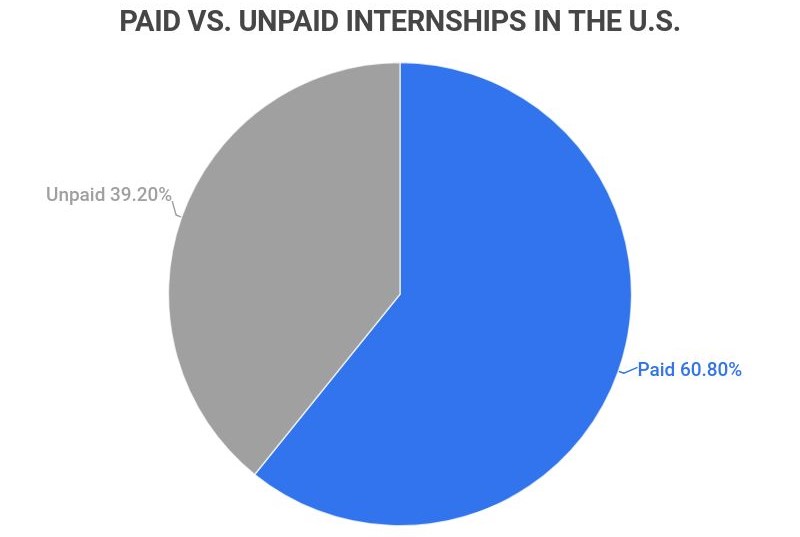
Currently, 39.2% of internships in the U.S. remain unpaid, while 60.8% are paid.
-
In the initial years post-graduation, former interns are 15% less likely to be unemployed and earn 6% more compared to their peers who did not intern.
-
Paid internships have a 32% higher likelihood of leading to full-time job offers compared to unpaid internships.
-
The national average hourly wage for paid interns stands at $20.76.
-
31% of graduates start internships after completing their degree.
For a deeper understanding, we’ve categorized the data into several sections:
Paid vs. Unpaid | Post-Internship Salary | Trends and Predictions | Industry Breakdown
Internship and Job Success Statistics
For most participants, internships serve as a stepping stone to employment in their chosen industry. Here are some compelling statistics that illustrate how internships contribute to job success:
-
The majority of students who complete an internship receive a full-time job offer after graduation.
Currently, 56% of all interns in the U.S. accept job offers from their internship employers, with an additional 14% receiving part-time job offers upon completion of their internships.
Impressively, 80% of interns who are offered jobs at their internship companies accept those positions.
-
Students and young professionals with internship experience are 35% more likely to receive job offers post-graduation compared to those without experience.
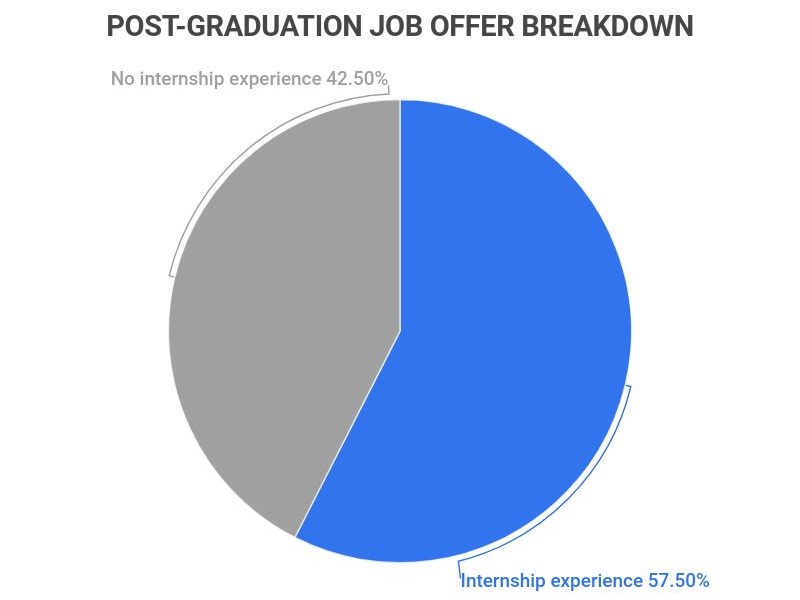
Among graduating seniors, 53.2% receive at least one job offer. Of those who receive offers, roughly 57.5% have completed at least one internship, while 42.5% have no internship experience.
-
70% of interns are extended job offers from the company they interned at, with only 20% declining.
Approximately 70% of interns nationally receive job offers from their internship employers, with 80% of those accepting those offers. Furthermore, 56% of all interns—both paid and unpaid—accept full-time job offers from their internship organizations. This high acceptance rate may be influenced by the fact that around 14% of employers report using signing bonuses to convert interns into full-time employees.
Paid vs. Unpaid Internship Statistics
Whether an internship is paid or unpaid significantly influences a candidate’s decision to participate. Many individuals cannot afford to work without compensation, even if the experience is valuable. Unfortunately, unpaid internships remain prevalent in certain sectors.
-
Nearly 40% of internships in the U.S. are unpaid.
Currently, 39.2% of internships are unpaid, primarily concentrated in the nonprofit, social service, and government sectors. Conversely, 60.8% of internships are paid, predominantly in private and for-profit organizations.
Experts assert that companies increasingly offer paid internships to attract new talent and retain dedicated full-time employees.
-
Paid internships are 32% more likely to lead to full-time job offers compared to unpaid internships.
Being compensated during an internship can significantly influence the likelihood of receiving job offers and securing full-time employment.
Employment data indicates that graduates who had paid internships in recent years received an average of 1.12 job offers, while those with unpaid internships received approximately 0.85 offers. Graduates without any internship experience averaged 0.64 job offers.
-
Fewer than 20% of U.S. interns are offered employer-sponsored health insurance.
Approximately 18% of employers provide health insurance to their interns, regardless of their paid or unpaid status.

Post-Internship Salary Statistics
Participating in an internship can significantly affect starting salaries. Many employers recognize the value of internship experience and are inclined to offer higher salaries. Here are some pertinent statistics:
-
The median starting salary for college graduates with internship experience is $47,470.
Graduates with internships are better positioned to secure college-level jobs, which typically yield a median salary of $47,470 annually. In contrast, graduates with limited or no internship experience often face underemployment, with a median annual salary of $37,330.
-
Graduates with internship experience are 15% less likely to be unemployed than those without.
Moreover, entry-level professionals with internship experience tend to earn approximately 6% more than their peers lacking such experience.
In summary, college graduates with internships not only enjoy lower unemployment rates but also start out with higher salaries, significantly impacting their lifetime earning potential.
Internship Trends and Predictions
Internships have evolved, especially concerning compensation. Today, a growing number of interns expect remuneration for their contributions, and many employers are responding positively. For instance:
-
The average hourly pay for interns increased by 6.2% from 2020 to 2021.
The average hourly wage for interns was $20.76 in 2020, reflecting a rise of $1.22 since 2019, when it was $19.54. This increase occurs alongside rising inflation in the job market.
-
The trend of rescinded internship offers has diminished significantly since the pandemic.
The majority of internships were canceled during 2020 due to the COVID-19 pandemic. However, the job market has since rebounded, leading to a resurgence in internship availability.
-
The unemployment rate for college graduates aged 20-24 has improved, showing a decline of 46.6% from 2020 to 2021.
Opportunities for young graduates are on the rise, with the unemployment rate for this demographic reaching 9.4% in July 2021, down from 17.6% in 2020.
Internship Statistics by Industry
Different sectors have varying expectations and norms regarding internships. This can be crucial for candidates unable to accept unpaid positions, as some fields are more likely to offer them. Here are the insights:
-
90% of congressional offices compensate their interns.
Most U.S. representatives pay their interns through government-allocated funds, with Senate interns averaging a monthly stipend of $1,986.75, while House interns receive about $1,612.53.
However, it’s important to note that 76% of paid congressional interns are white and attend private institutions.
-
Entry-level professionals interning with large tech firms receive the highest compensation rates.
Tech companies consistently rank at the top for intern compensation. Currently, the highest paying internship programs are at NVIDIA, Facebook, and LinkedIn, where interns can earn over $8,000 monthly.
-
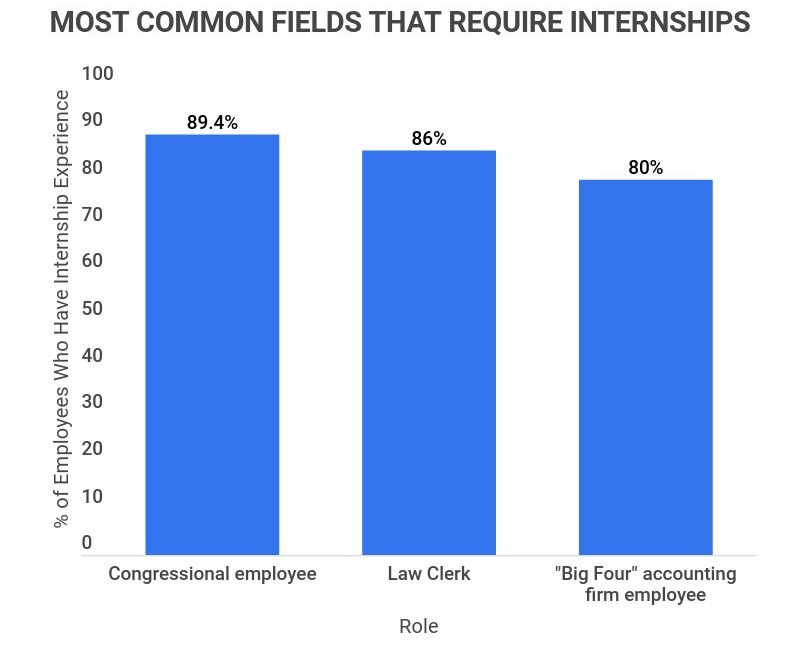
Legal, congressional, and accounting sectors are among the most common fields requiring internships.
Remarkably, 89.4% of congressional staff members have previously held at least one internship. Similarly, 86% of law clerks and 80% of employees at the Big Four accounting firms—PwC, Deloitte, KPMG, and EY—have some internship experience.
Internship FAQ
-
How common are paid internships?
Paid internships are prevalent in the U.S., with 60.8% being paid and 39.2% unpaid. Contrary to common belief, paid internships are now more widespread than unpaid ones.
Employers are increasingly recognizing the value of nurturing talent internally and are keen to retain their intern workforce. Offering fair compensation is a significant part of this strategy.
-
What percentage of undergraduates participate in internships?
Approximately 60% of college undergraduates and recent graduates engage in internships. This experience greatly enhances their chances of securing full-time employment post-education. Most undergraduates participate in at least one internship before or after graduation.
-
Yes, interns are assigned a considerable amount of work, though it often isn’t highly-skilled. Generally, both paid and unpaid interns are expected to perform tasks and contribute to their teams similarly to full-time employees.
While many assume that interns engage in busy work, successful interns typically handle smaller assignments and support specific departments within an organization. While responsibilities vary by industry, interns are expected to assist in operations while gaining insights into their respective fields and growing as professionals.
-
Yes, unpaid internships are legal, provided specific criteria are met by the employer. Unpaid internships are entirely permissible in government and nonprofit sectors. However, the regulations become complex with for-profit organizations.
For-profit companies can only offer unpaid internships if they can demonstrate that the internship benefits the intern more than the company—often validated by providing college credit for successful completion of the internship.
The legality of unpaid internships is nuanced, so if you are working for a private company without receiving college credit, it is likely you should be compensated.
-
What percentage of interns are offered a job?
70% of interns receive job offers from the companies where they interned. Of these offers, 56% are full-time positions and 14% are part-time. Notably, 80% of interns accept these job offers.
-
Do internships actually help you get a job?
Yes, internships significantly enhance your chances of employment. Even interns who do not receive job offers from their internship companies report higher employment rates post-graduation.
In fact, having internship experience can boost a graduate’s likelihood of receiving at least one job offer by up to 32% in the months following graduation.
-
Do unpaid internships look bad on a resume?
No, unpaid internships do not negatively impact your resume. It is advisable not to specify the payment status of your internship on your resume. As long as it was a legitimate experience and your former employer can verify your responsibilities, potential employers will be satisfied.
Additionally, if asked about past compensation during an interview, focus on the value you contributed and relevant salary data for the industry, role, and location of the position you are applying for, rather than disclosing that your internship was unpaid.
Conclusion
Internships are undeniably pivotal for long-term career success. For college students and emerging professionals, internships and apprenticeships play a vital role in securing full-time employment, enhancing salary potential, and obtaining competitive benefits packages.
In the United States, it is estimated that 300,000 individuals participate in internships each year, with just over 60% receiving compensation—a figure that defies common misconceptions. While the internship landscape faced challenges during the COVID-19 pandemic, it has since recovered and continues to evolve.
Today, more than half of all interns are hired by the companies where they interned, demonstrating a clear correlation between internship completion and successful entry into the workforce.
References
-
Spectrum News 1. “Job Market Uncertain For Future College Graduates.” Accessed on October 17, 2021.
-
Chegg Internships. “Internships By The Numbers.” Accessed on October 17, 2021.
-
CNBC. “Paid Internship Wages Are The Highest They’ve Ever Been—But There’s A Catch.” Accessed on October 17, 2021.
-
College Recruiter. “How Internships Impact Employability And Salary.” Accessed on October 17, 2021.
-
Glassdoor. “25 Highest Paying Internships For 2021.” Accessed on October 17, 2021.
-
CNBC. “Say Goodbye To Six Figure Starting Salaries—With These Exceptions.” Accessed on October 17, 2021.
-
PR Newswire. “Pay Our Interns: Pay And Racial Disparities Are Still Rampant In Congressional Internships.” Accessed on October 17, 2021.
-
The Conversation. “COVID-19 Shows Why It’s Time To Finally End Unpaid College Internships.” Accessed on October 17, 2021.
-
SSRN. “Door Opener or Waste of Time? The Effects of Student Internships on Labor Market Outcomes.” Accessed on January 11, 2022.
-
Springer Link. “Stairway to employment? Internships in higher education.” Accessed on January 11, 2022.
-
NACE. “Paid Internships: Moving Toward Greater Equity, Setting Pay.” Accessed on February 9, 2023.
- Job Seeker Statistics
- Career Change statistics
- Internship Statistics
- Job Search Statistics
- Average Number Of Jobs Applied
- Average Salary Increase When Changing Jobs
- Part Time Job Statistics
- Age Discrimination Statistics
- Networking Statistics
- Interview Statistics
- Average Number of Jobs In A Lifetime
- Resume Statistics
- Side Hustle Statistics
- Teacher Statistics

Author

Elsie is an experienced writer, reporter, and content creator. As a leader in her field, Elsie is best known for her work as a Reporter for The Southampton Press, but she can also be credited with contributions to Long Island Pulse Magazine and Hamptons Online. She holds a Bachelor of Arts degree in journalism from Stony Brook University and currently resides in Franklin, Tennessee.