What does an analytics consultant do?
An analytics consultant is an individual who develops new and innovative analytical solutions that meet the requirements of clients and businesses. Analytics consultants must understand the organization's business strategy by creating analytical solutions and providing analysis on the effectiveness of its marketing campaigns. They must respond to the request of market intelligence executives and provide attractive business solutions. Analytics consultants must also guide properly the industry analysts regarding market share information as well as competition in the local market.
Analytics consultant responsibilities
Here are examples of responsibilities from real analytics consultant resumes:
- Develop tools in excel (VBA macros) to automate frequently used processes.
- Manage paid search, SEO & PPC campaigns across multiple engines and ensure program specific ROI goals are being meet.
- Lead design effort to document system component diagrams across various domains for a new product implementation within a non-profit healthcare company.
- Lead PeopleSoft ERP implementations for professional service companies.
- Manage business intelligence and analytics projects and new initiatives for various business units/divisions at AHM; e.g.
- Manage technical infrastructure, application development, and other capital improvement projects for early stage Internet start-ups and non-profit organizations.
- Used ETL (SSIS) to develop jobs for extracting, cleaning, transforming and loading data into data warehouse.
- Develop a SAS code for optimization of products between warehouses and direct sales using multivariate regression analysis.
- Experience in writing batch processing huge Scala programs.
- Create and deploy SSRS reports on the portal for user accessibility.
- Modify the existing SSIS packages to meet the changes specify by the users.
- Design applications for storing data to HDFS by using Kafka to get more performance.
- Create, develop and deploy tabular, matrix, list, drill-down, drill-through using SSRS.
- Create a metric base PowerPoint presentation for the CEO to present to the bank's board of directors.
- Investigate forecast anomalies, identify root cause, and notify data warehouse team of any suspect ETL failures.
Analytics consultant skills and personality traits
We calculated that 8% of Analytics Consultants are proficient in Data Analytics, Visualization, and SAS. They’re also known for soft skills such as Analytical skills, Communication skills, and Interpersonal skills.
We break down the percentage of Analytics Consultants that have these skills listed on their resume here:
- Data Analytics, 8%
Develop actionable, insightful data analytics and reporting for internal BCA customers with business performance, including root cause analysis.
- Visualization, 7%
Collaborated with business owners to determine visualization needs.
- SAS, 7%
Develop SAS processes for business users to extracts summarized data and distribute business summary reports through automated email.
- Python, 6%
Performed general system administration and automation tasks with bash and Python.
- Data Analysis, 5%
Presented to Safety and Operations leadership potential problem areas indicated by our data analysis and worked with leadership to implement solutions.
- Econometrics, 5%
Acquired econometrics measures and developed variables that enhanced forecast accuracy.
"data analytics," "visualization," and "sas" are among the most common skills that analytics consultants use at work. You can find even more analytics consultant responsibilities below, including:
Analytical skills. One of the key soft skills for an analytics consultant to have is analytical skills. You can see how this relates to what analytics consultants do because "management analysts must be able to interpret information and use their findings to make proposals." Additionally, an analytics consultant resume shows how analytics consultants use analytical skills: "provide testing and optimization recommendations to business and marketing stakeholder through presentations and data visualization. "
Communication skills. Many analytics consultant duties rely on communication skills. "management analysts must be able to convey information clearly in both writing and speaking," so an analytics consultant will need this skill often in their role. This resume example is just one of many ways analytics consultant responsibilities rely on communication skills: "provide project management support on scheduling, sizing estimates, and project communication for midrange projects. "
Interpersonal skills. Another skill that relates to the job responsibilities of analytics consultants is interpersonal skills. This skill is critical to many everyday analytics consultant duties, as "management analysts work with managers and other employees of the organizations for which they provide consulting services." This example from a resume shows how this skill is used: "achieved exceptional customer service recognition through applying professional interpersonal communicative skills successfully exceeded company objectives through applied sales-driven personality"
Problem-solving skills. analytics consultant responsibilities often require "problem-solving skills." The duties that rely on this skill are shown by the fact that "management analysts must be able to think creatively to solve clients’ problems." This resume example shows what analytics consultants do with problem-solving skills on a typical day: "develop solutions for data visualization and statistical analysis. "
Time-management skills. A commonly-found skill in analytics consultant job descriptions, "time-management skills" is essential to what analytics consultants do. Analytics consultant responsibilities rely on this skill because "management analysts often work under tight deadlines and must use their time efficiently to complete projects on schedule." You can also see how analytics consultant duties rely on time-management skills in this resume example: "led requirement elicitation & management, and led uat to successful completion against stringent deadlines. "
The three companies that hire the most analytics consultants are:
- Wells Fargo456 analytics consultants jobs
- Deloitte347 analytics consultants jobs
- MassMutual103 analytics consultants jobs
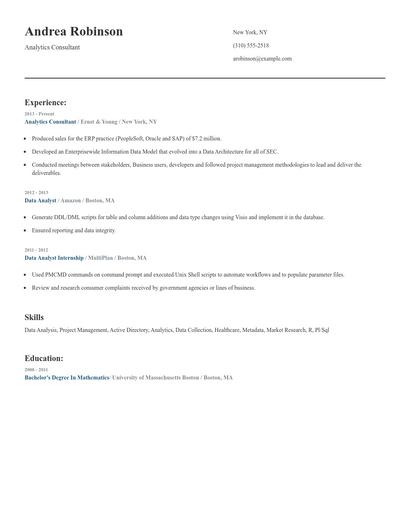
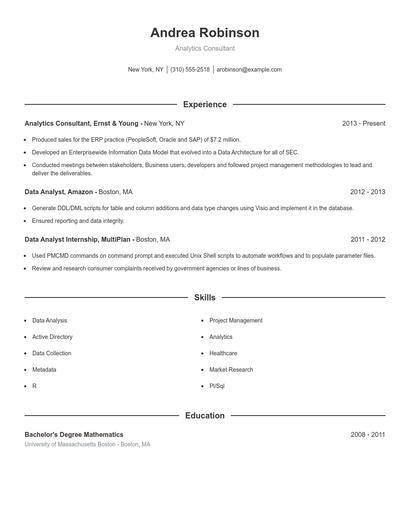
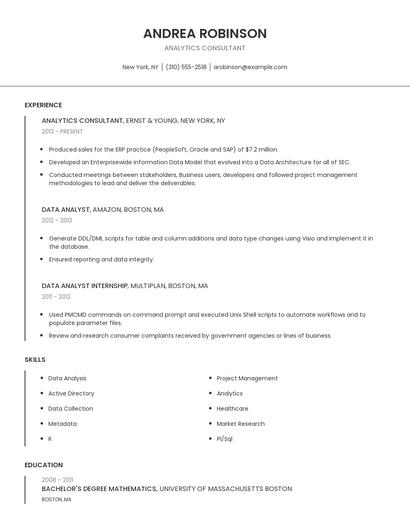
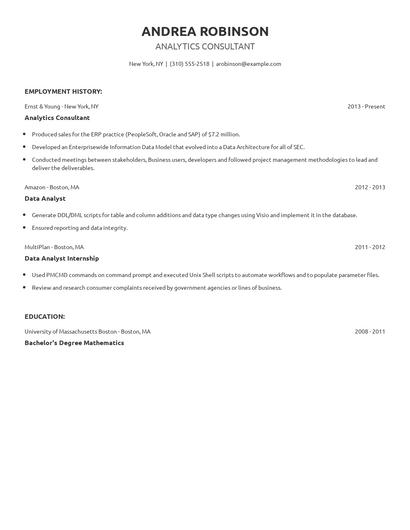
Choose from 10+ customizable analytics consultant resume templates
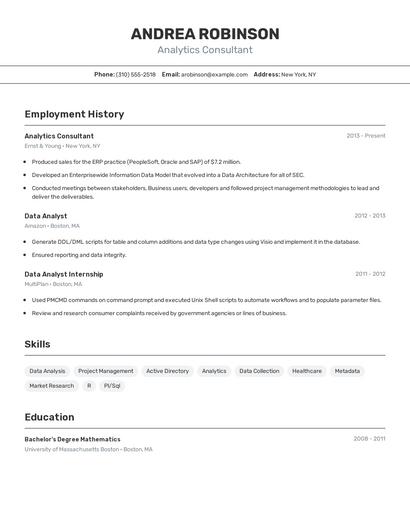
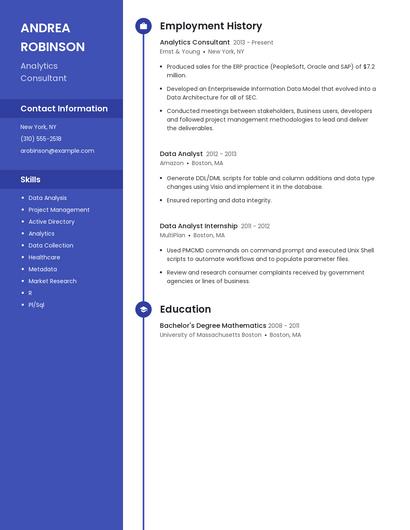
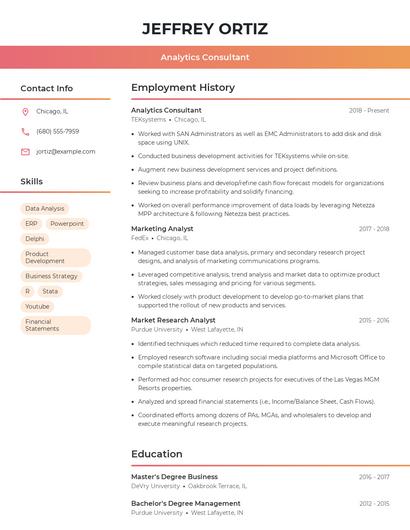
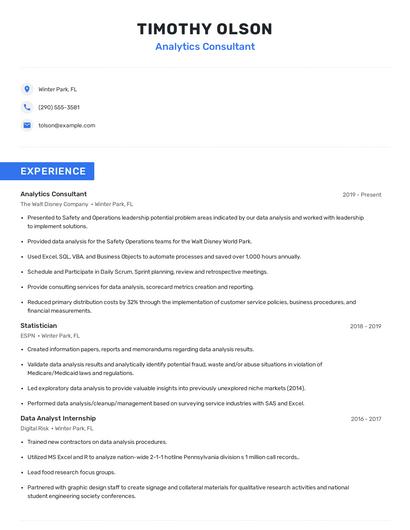
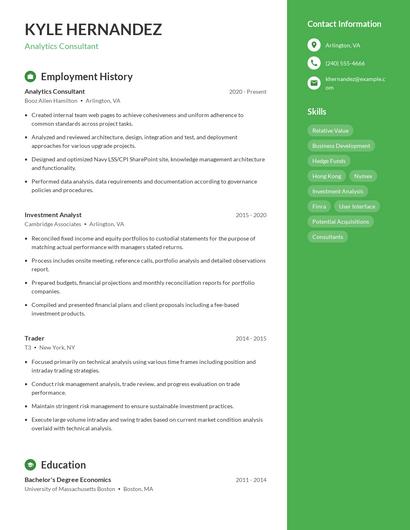
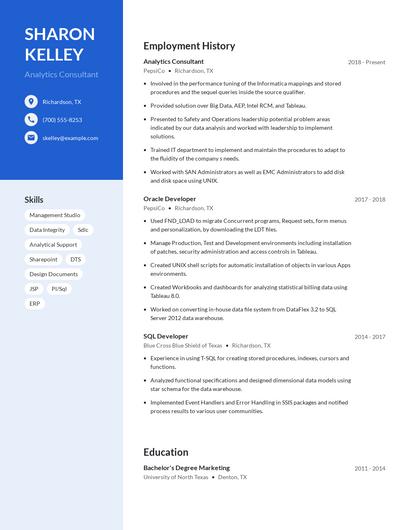
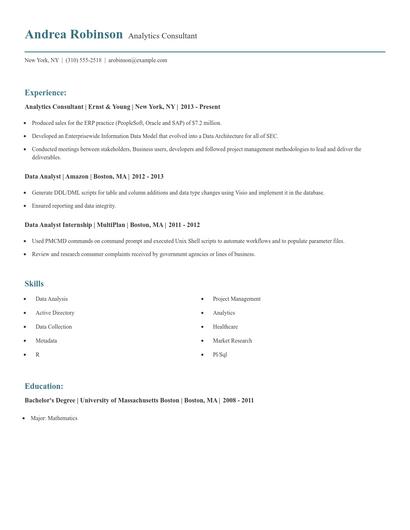
Build a professional analytics consultant resume in minutes. Our AI resume writing assistant will guide you through every step of the process, and you can choose from 10+ resume templates to create your analytics consultant resume.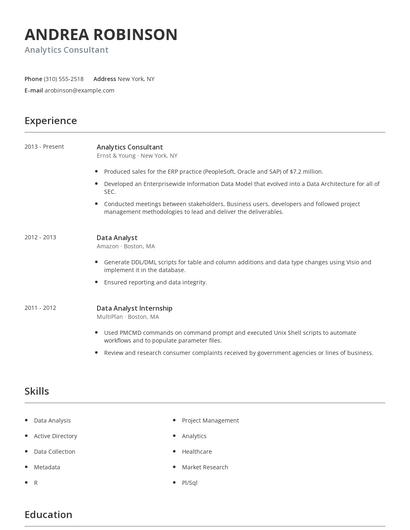
Compare different analytics consultants
Analytics consultant vs. Control analyst
A control analyst is an individual who is responsible for identifying weaknesses in the work process of an organization and implement methods to minimize risks. Control analysts are required to supervise the process for incident reports and provide technical guidance to their personnel. They must prepare monthly general ledger account analysis and balance sheets reconciliations that are according to the generally accepted accounting principles (GAAP). Control analysts should also assist with the organization's ISO audit procedures and findings.
While similarities exist, there are also some differences between analytics consultants and control analyst. For instance, analytics consultant responsibilities require skills such as "data analytics," "visualization," "sas," and "python." Whereas a control analyst is skilled in "internal controls," "risk assessments," "sox," and "internal audit." This is part of what separates the two careers.
Control analysts earn the highest salaries when working in the energy industry, with an average yearly salary of $89,191. On the other hand, analytics consultants are paid more in the professional industry with an average salary of $90,302.On average, control analysts reach lower levels of education than analytics consultants. Control analysts are 15.8% less likely to earn a Master's Degree and 2.5% less likely to graduate with a Doctoral Degree.Analytics consultant vs. Program management consultant
A program management consultant is responsible for analyzing project requirements based on clients' specifications, developing quality improvement techniques, and reviewing project deliverables. Program management consultants work closely with the project team to identify project initiatives and resolve complexities that may arise. They also inspect the resources and materials to be utilized during the project and determine cost-reduction processes without compromising quality and efficiency. A program management consultant coordinates with the clients for progress updates and informs them of any plan adjustments as needed.
While some skills are similar in these professions, other skills aren't so similar. For example, resumes show us that analytics consultant responsibilities requires skills like "data analytics," "visualization," "sas," and "python." But a program management consultant might use other skills in their typical duties, such as, "customer service," "management program," "healthcare," and "scrum."
Program management consultants may earn a higher salary than analytics consultants, but program management consultants earn the most pay in the technology industry with an average salary of $107,612. On the other hand, analytics consultants receive higher pay in the professional industry, where they earn an average salary of $90,302.program management consultants earn lower levels of education than analytics consultants in general. They're 6.7% less likely to graduate with a Master's Degree and 2.5% less likely to earn a Doctoral Degree.Analytics consultant vs. Senior management consultant
A senior management consultant is an experienced professional who is in charge of a team of management consultants to help an organization solve issues, maximize growth, and improve business performance. Senior management consultants must conduct company research so that they can better understand the organization. They prepare business proposals and presentations as well as identify issues to form hypotheses and solutions. Senior management consultants must also implement recommendations or solutions and ensure that an organization receives the necessary assistance to carry it all out.
There are many key differences between these two careers, including some of the skills required to perform responsibilities within each role. For example, an analytics consultant is likely to be skilled in "data analytics," "sas," "python," and "data analysis," while a typical senior management consultant is skilled in "analytics," "business development," "portfolio," and "business analysis."
Senior management consultants make a very good living in the technology industry with an average annual salary of $135,771. On the other hand, analytics consultants are paid the highest salary in the professional industry, with average annual pay of $90,302.senior management consultants typically earn similar educational levels compared to analytics consultants. Specifically, they're 4.1% less likely to graduate with a Master's Degree, and 0.9% less likely to earn a Doctoral Degree.Analytics consultant vs. Senior business consultant
A senior business consultant specializes in performing research and analysis to optimize business processes. Their responsibilities revolve around coordinating with different departments to gather necessary data, devising strategies to reduce cost, assess risks, and identify the strength and weaknesses of operations to recommend solutions. They may also train and mentor junior consultants, produce progress reports and presentations, and assist clients through calls and correspondence. Furthermore, as a consultant, it is essential to adhere to the company's policies and regulations, including its vision and mission.
Types of analytics consultant
Updated January 8, 2025
