What does a merchandise analyst do?
A merchandise analyst is an individual who monitors inventory levels while following and charting the profits and sales of a store or company. Merchandise analysts are required to identify appropriate industry and product categories so that they can focus on maximizing the business of each store. They must review and analyze weekly advertisement results with team members to meet their sales goals as well as identify causes of high carryover and methods for reduction. Merchandise analysts must also use data analysis to identify markets and fine-tune merchandise.
Merchandise analyst responsibilities
Here are examples of responsibilities from real merchandise analyst resumes:
- Manage a team of allocation analysts who distribute fashion jewelry to more than a thousand stores
- Analyze and forecast sales, manage inventory levels and determine distribution strategy to all Marshalls stores.
- Manage and maintain the OTB for specific departments by preparing forecasts, evaluating performance, and maximizing profitability while minimizing liabilities.
- Allocate product to the appropriate stores using JDA system.
- Analyze and allocate for women's intimate apparel, and accessories.
- Analyze historical POS to create seasonal profiles for all items, allowing the system to more efficiently predict seasonal trends.
- Allocate and replenish men's and license apparel, base on previous performance; determine what each store should receive.
- Lead monthly OTB meeting to address any opportunities/risk to executive committee in monthly forecasting meeting.
- Complete daily tally, communication logs, benefit updates, medical policy reviews and review policies and procedures using SharePoint applications.
- Used MMS system to ensure allocations meet MMS plans.
- Assist in the development of replenishment reporting tools for core jewelry.
- Enter Po s and markdowns in the RMS Retek system.
- Analyze and forecast sales, manage inventory levels and determine distribution strategy to all Marshalls stores.
Merchandise analyst skills and personality traits
We calculated that 14% of Merchandise Analysts are proficient in PowerPoint, SQL, and Data Analysis. They’re also known for soft skills such as Detail oriented, Analytical skills, and Communication skills.
We break down the percentage of Merchandise Analysts that have these skills listed on their resume here:
- PowerPoint, 14%
Created Excel reports and PowerPoint presentations for senior staff and board of director meetings.
- SQL, 8%
Gathered data, created tables, and provided analysis for the Monthly Operations Review, using SQL interface.
- Data Analysis, 7%
Developed insights from data analysis and research that drove fundamental improvements to the site usability and user experience.
- Digital Marketing, 5%
Led digital marketing project for e-commerce platform offering.
- Gross Profit, 5%
Provided accurate recommendations to management on how gross profit can be maximized.
- Logistics, 4%
Trained and supervised two Merchandise Analysts and one Logistics Coordinator.
"powerpoint," "sql," and "data analysis" are among the most common skills that merchandise analysts use at work. You can find even more merchandise analyst responsibilities below, including:
Detail oriented. To carry out their duties, the most important skill for a merchandise analyst to have is detail oriented. Their role and responsibilities require that "market research analysts must pay attention to minutiae to evaluate data." Merchandise analysts often use detail oriented in their day-to-day job, as shown by this real resume: "provided detailed weekly reporting and analysis of regional sales and assist with store performance strategies. "
Analytical skills. Another essential skill to perform merchandise analyst duties is analytical skills. Merchandise analysts responsibilities require that "market research analysts must evaluate large amounts of data and information related to market conditions." Merchandise analysts also use analytical skills in their role according to a real resume snippet: "analyzed sales product performance by brand and by channel. "
Communication skills. Another skill that relates to the job responsibilities of merchandise analysts is communication skills. This skill is critical to many everyday merchandise analyst duties, as "market research analysts must be able to clearly convey information when gathering material, interpreting data, and presenting results to clients." This example from a resume shows how this skill is used: "acquire accurate and precise information through constant communication with distribution centers and vendors. "
The three companies that hire the most merchandise analysts are:
- United Natural Foods12 merchandise analysts jobs
- Bob's Discount Furniture6 merchandise analysts jobs
- Williams Sonoma4 merchandise analysts jobs
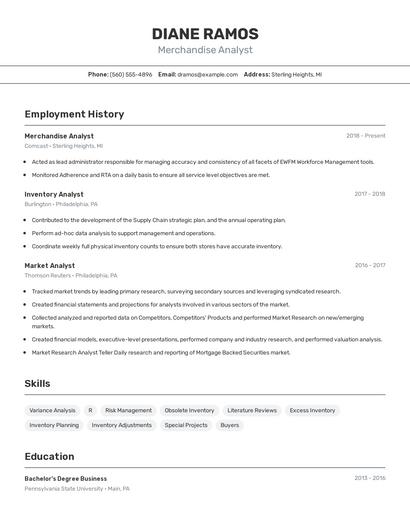
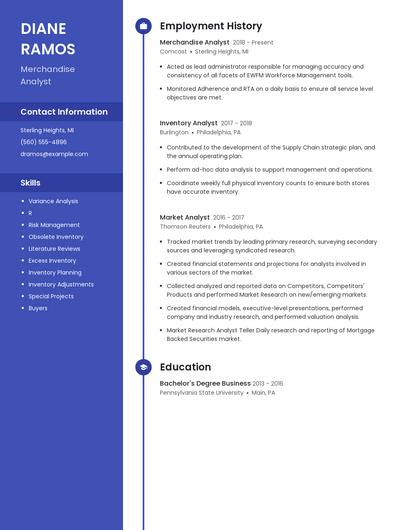
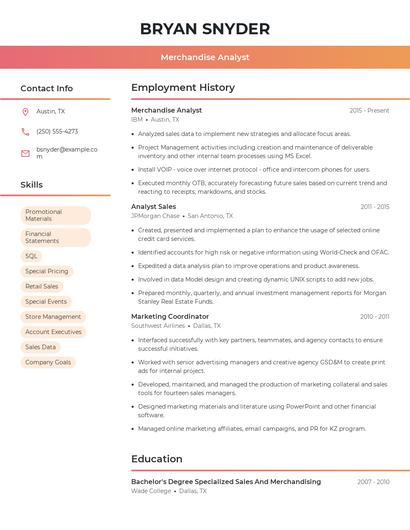
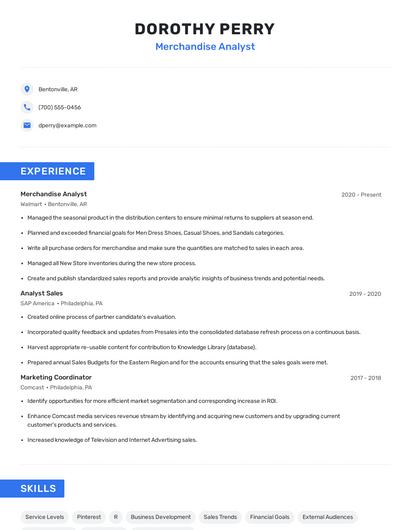
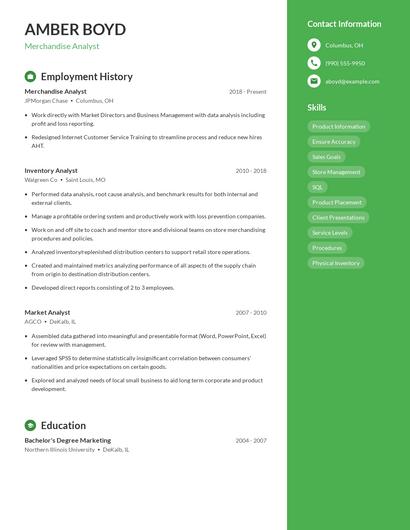
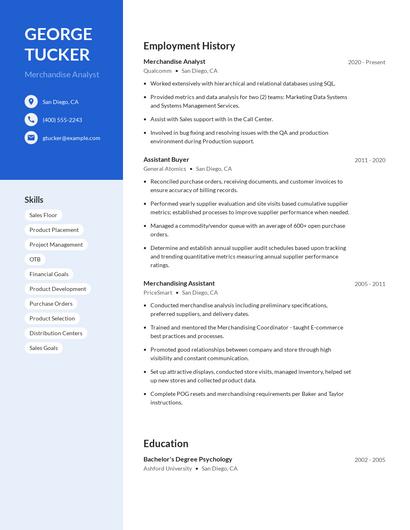
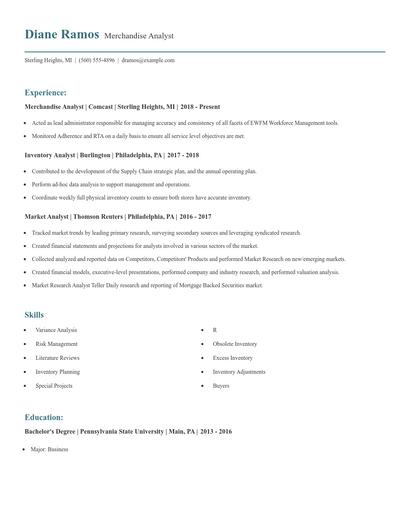
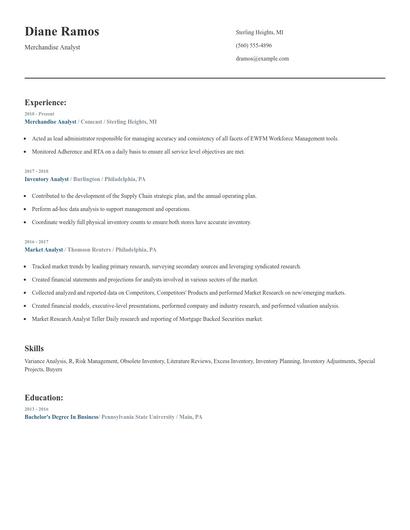
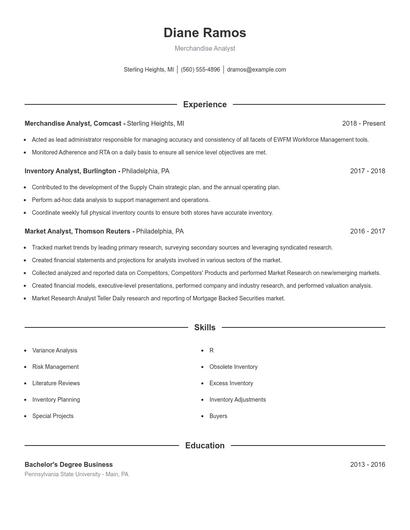
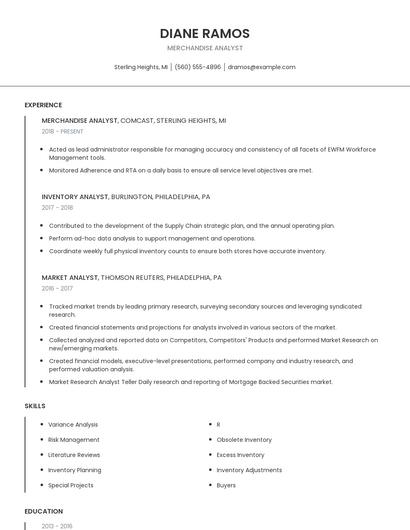
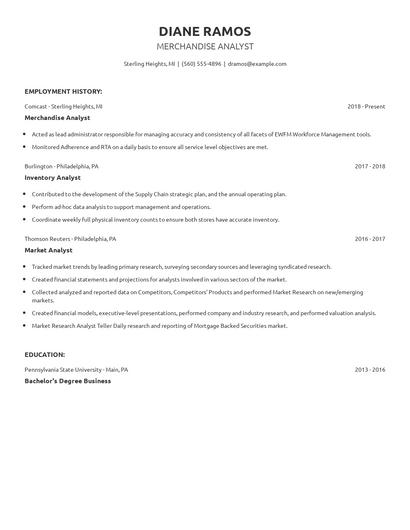
Choose from 10+ customizable merchandise analyst resume templates
Build a professional merchandise analyst resume in minutes. Our AI resume writing assistant will guide you through every step of the process, and you can choose from 10+ resume templates to create your merchandise analyst resume.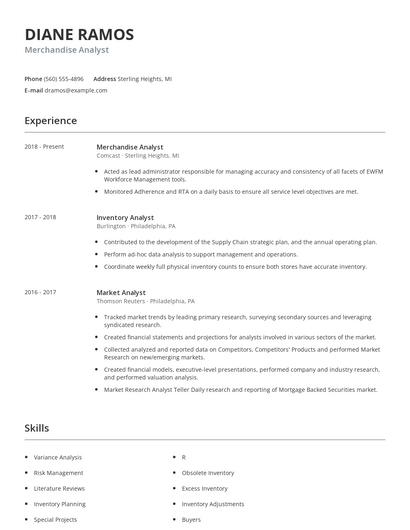
Compare different merchandise analysts
Merchandise analyst vs. Marketing department internship
A marketing department internship is a marketing degree program requirement in most colleges. This is the work experience period where interns get to apply the knowledge they acquire in the real world. In this period, marketing interns provide administrative support to the marketing department of the company. The duties may include data entry, preparation of marketing materials, and managing the company's website. Also, interns are tasked to research and collect data, then analyze findings with an experienced marketing representative's supervision.
These skill sets are where the common ground ends though. The responsibilities of a merchandise analyst are more likely to require skills like "digital marketing," "gross profit," "logistics," and "purchase orders." On the other hand, a job as a marketing department internship requires skills like "financial statements," "press releases," "r," and "market research." As you can see, what employees do in each career varies considerably.
The education levels that marketing department interns earn slightly differ from merchandise analysts. In particular, marketing department interns are 4.8% more likely to graduate with a Master's Degree than a merchandise analyst. Additionally, they're 1.3% more likely to earn a Doctoral Degree.Merchandise analyst vs. Marketing internship
Marketing interns are usually marketing students or fresh graduates who are interested in getting actual work experiences before taking on a full-time job. They usually have an interest or academic background related to marketing. They assist marketing teams in most of their daily activities, sit in their meetings, record minutes of these meetings, take note of action plans, and attend other events related to marketing. They also assist in preparing collateral and other marketing materials, join brainstorming sessions, or any other activity that will help enrich their experience.
Each career also uses different skills, according to real merchandise analyst resumes. While merchandise analyst responsibilities can utilize skills like "sql," "gross profit," "logistics," and "purchase orders," marketing interns use skills like "facebook," "marketing campaigns," "press releases," and "twitter."
Marketing interns earn a lower average salary than merchandise analysts. But marketing interns earn the highest pay in the technology industry, with an average salary of $33,333. Additionally, merchandise analysts earn the highest salaries in the retail with average pay of $70,062 annually.In general, marketing interns achieve similar levels of education than merchandise analysts. They're 0.2% less likely to obtain a Master's Degree while being 1.3% more likely to earn a Doctoral Degree.Merchandise analyst vs. Marketing consultant
A marketing consultant is responsible for utilizing their extensive retail expertise to develop strategies on how to strengthen client base and achieve better sales. Furthermore, a marketing consultant must perform research and analysis to determine opportunities for financial gains, devise plans to improve client satisfaction, assess the competition, look out for any risks, and develop its brand and image. They should also ensure that all steps taken adhere to the policies and regulations of the organization.
There are many key differences between these two careers, including some of the skills required to perform responsibilities within each role. For example, a merchandise analyst is likely to be skilled in "sql," "data analysis," "gross profit," and "logistics," while a typical marketing consultant is skilled in "customer service," "web content," "media sales," and "marketing campaigns."
Marketing consultants earn the highest salary when working in the technology industry, where they receive an average salary of $93,209. Comparatively, merchandise analysts have the highest earning potential in the retail industry, with an average salary of $70,062.marketing consultants typically earn higher educational levels compared to merchandise analysts. Specifically, they're 6.9% more likely to graduate with a Master's Degree, and 0.4% more likely to earn a Doctoral Degree.Merchandise analyst vs. Marketing assistant
A marketing assistant's general responsibility is to support the marketing programs and campaigns by sharing recommendations and useful insights to improve the brand's image. Marketing assistants' duties also include reaching out to other personnel for necessary files needed on promotional advertisements, assist the team in creating designs and developing content, publishing brochures for potential clients, analyzing sales reports, and researching the current market trends. A marketing assistant should have excellent organizational and time-management skills to meet deadlines and perform various tasks as required.
Types of merchandise analyst
Updated January 8, 2025
