What does a receptionist/security officer do?
Receptionist/security officer responsibilities
Here are examples of responsibilities from real receptionist/security officer resumes:
- Certify in first aid, CPR, and a.
- Maintain a high level of alertness to ensure the well-being of their corporate clients HSBC.
- Monitor all event activity, CCTV and maintain control over customers, residents and staff traffic throughout the property.
- Monitor computer alarm systems, closed-circuit television (CCTV) systems and communicate by radio with mobile units to attend alarms
- Patrol facility area and look for anything out of place: leaks, machinery not working properly, people, etc.
- Foot patrol of interior and exterior to check / lock / unlock gates, entrances, doors, windows and vents.
- Maintain a standard of punctuality and dependability of attendance and retain myself cleanliness, tidiness, neatness and appropriately attire.
- Perform personal escorts, VIP services, and experience in controlling and deescalating physical altercations and accidents among customers and personnel.
Receptionist/security officer skills and personality traits
We calculated that 23% of Receptionist/Security Officers are proficient in Customer Service, Visitor Badges, and Front Desk. They’re also known for soft skills such as Communication skills, Good judgment, and Observation skills.
We break down the percentage of Receptionist/Security Officers that have these skills listed on their resume here:
- Customer Service, 23%
Answered questions and resolved or referred concerns by communicating proactively and demonstrating commitment to high quality customer service.
- Visitor Badges, 17%
Maintained security by following procedures; monitored logbook; and issued visitor badges
- Front Desk, 10%
Front Desk Administrator responsible for maintaining daily security logs regarding arrival and departures of the building.
- Patrol, 8%
Monitored Notifier panel system and dispatched patrol officer to certain location.
- Client Facility, 7%
Serve as first point of contact and gatekeeper for client facility by welcoming and directing on-site visitors.
- Safety Hazards, 5%
Monitor for irregularities, such as security breaches, facility and safety hazards
Most receptionist/security officers use their skills in "customer service," "visitor badges," and "front desk" to do their jobs. You can find more detail on essential receptionist/security officer responsibilities here:
Communication skills. One of the key soft skills for a receptionist/security officer to have is communication skills. You can see how this relates to what receptionist/security officers do because "security guards and surveillance officers must communicate effectively with others, even in stressful situations." Additionally, a receptionist/security officer resume shows how receptionist/security officers use communication skills: "monitored alarm system status and off-hour telecommunication systems. "
Observation skills. receptionist/security officers are also known for observation skills, which are critical to their duties. You can see how this skill relates to receptionist/security officer responsibilities, because "security guards and surveillance officers must be alert and aware of their surroundings, and be able to quickly recognize anything out of the ordinary." A receptionist/security officer resume example shows how observation skills is used in the workplace: "maintained daily logs, complete safe checks and generate observations and incident reports. "
The three companies that hire the most receptionist/security officers are:
- Allied Universal
24 receptionist/security officers jobs
- Securitas AB23 receptionist/security officers jobs
- Denali2 receptionist/security officers jobs
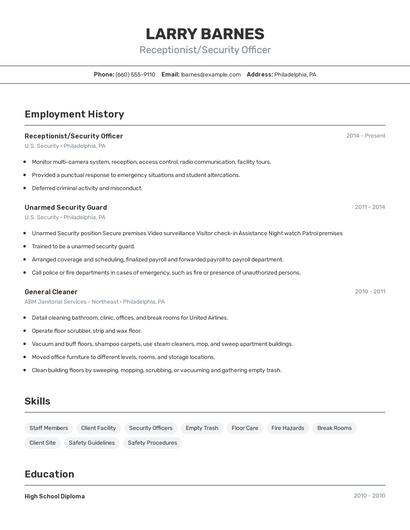
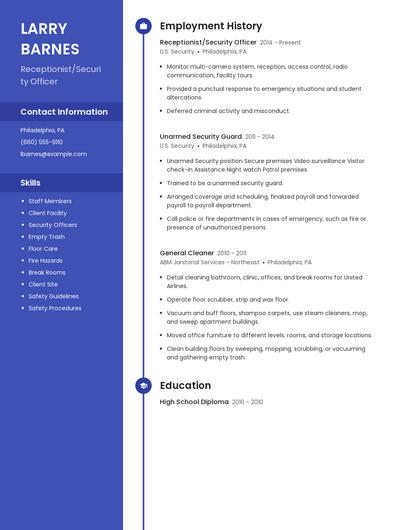
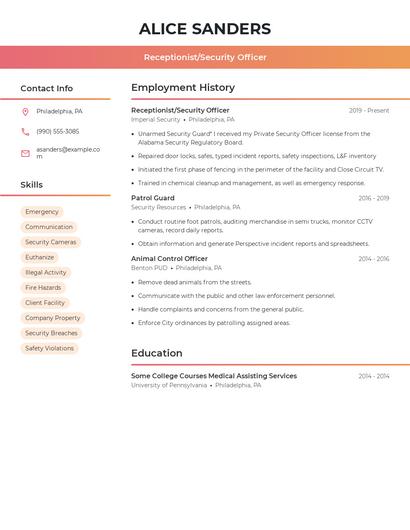
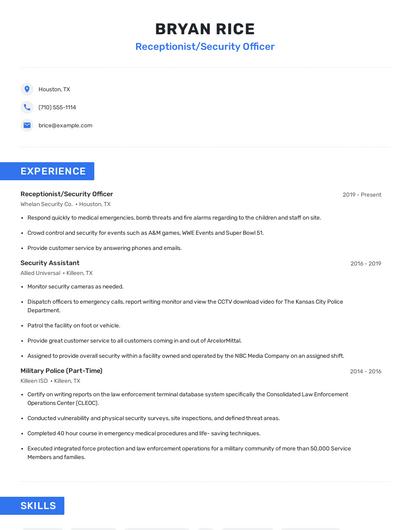
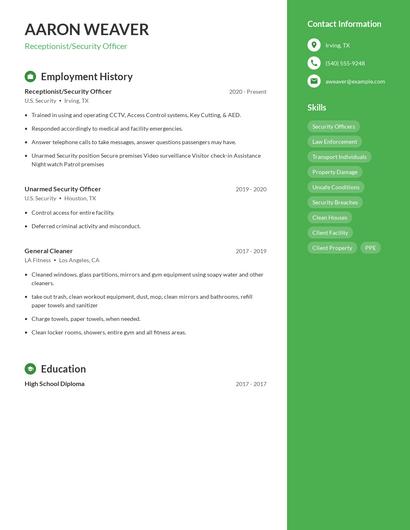
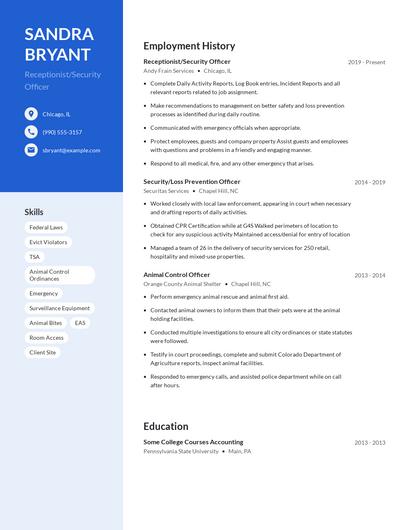
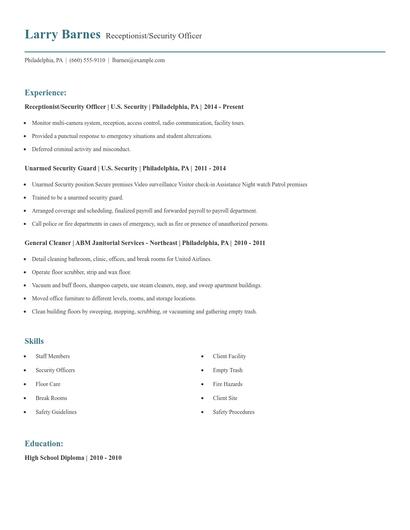
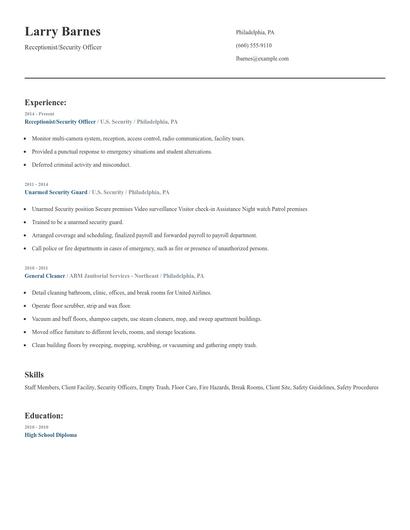
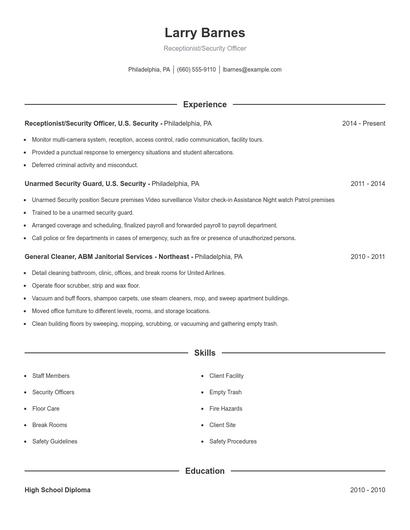
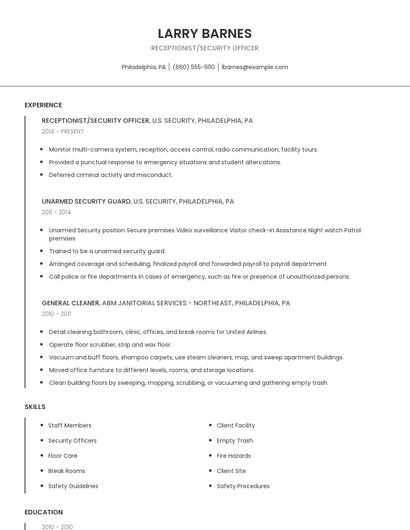
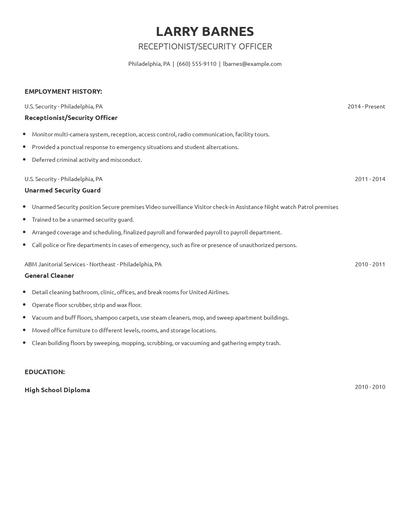
Choose from 10+ customizable receptionist/security officer resume templates
Build a professional receptionist/security officer resume in minutes. Our AI resume writing assistant will guide you through every step of the process, and you can choose from 10+ resume templates to create your receptionist/security officer resume.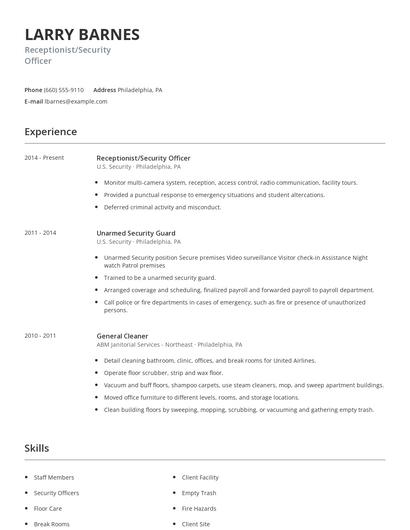
Compare different receptionist/security officers
Receptionist/security officer vs. Officer
An officer is responsible for managing the daily operations of the assigned area, ensuring its peace and security by monitoring and reporting unusual and suspicious activities. Officers are the ones enforcing strict safety protocols and procedures to maintain the order within the premises. They also coordinate with law enforcement agencies in conducting appropriate investigations for any violating cases. An officer must be highly-knowledgeable of the law policies, as well as possessing excellent leadership skills to manage the members under the officer's patrol.
These skill sets are where the common ground ends though. The responsibilities of a receptionist/security officer are more likely to require skills like "visitor badges," "provides administrative support," "front desk," and "client facility." On the other hand, a job as an officer requires skills like "public safety," "powerpoint," "law enforcement agencies," and "financial statements." As you can see, what employees do in each career varies considerably.
The education levels that officers earn slightly differ from receptionist/security officers. In particular, officers are 9.1% more likely to graduate with a Master's Degree than a receptionist/security officer. Additionally, they're 1.8% more likely to earn a Doctoral Degree.Receptionist/security officer vs. Security specialist
A security specialist is responsible for maintaining the security of an organization's database, ensuring that it's free from cyber threats and unusual activities. Security specialists' duties include upgrading hardware and software applications, configuring networks to improve optimization, addressing any unauthorized access on the database, troubleshooting system discrepancies, conducting security audits on the system, and improving automated processes. A security specialist must have a strong command of programming languages and system codes, as well as broad experience with technical expertise.
Each career also uses different skills, according to real receptionist/security officer resumes. While receptionist/security officer responsibilities can utilize skills like "visitor badges," "front desk," "client facility," and "safety hazards," security specialists use skills like "ladders," "security incidents," "physical security," and "security clearance."
Average education levels between the two professions vary. Security specialists tend to reach higher levels of education than receptionist/security officers. In fact, they're 5.1% more likely to graduate with a Master's Degree and 1.8% more likely to earn a Doctoral Degree.Receptionist/security officer vs. Unarmed security guard
The primary responsibility of an unarmed security guard is to monitor and protect properties against damage or criminal attack. They must be alert, patrol the premises, and respond to emergencies. They also monitor alarm systems and video surveillance cameras. In cases of security breaches, they are expected to bring in law enforcement agents.
The required skills of the two careers differ considerably. For example, receptionist/security officers are more likely to have skills like "customer service," "visitor badges," "provides administrative support," and "client facility." But a unarmed security guard is more likely to have skills like "unarmed security," "english language," "unarmed guard," and "incident reports."
Unarmed security guards earn the highest salary when working in the utilities industry, where they receive an average salary of $31,285. Comparatively, receptionist/security officers have the highest earning potential in the utilities industry, with an average salary of $31,888.When it comes to education, unarmed security guards tend to earn similar degree levels compared to receptionist/security officers. In fact, they're 0.5% less likely to earn a Master's Degree, and 0.3% less likely to graduate with a Doctoral Degree.Receptionist/security officer vs. Security
A Security's main responsibility is to keep people or an establishment safe. This responsibility is carried out by constantly patrolling a designated area and monitoring the activity within the premises. Most of the tasks involved are inspecting buildings and equipment, monitoring entry and exit points, reporting irregularities, responding to customers in distress, and other surveillance activities. The security is basically an establishment's first line of defense, this is why one must have good communication skills, keen observation and judgment, and as well as presence of mind.
Types of receptionist/security officer
Updated January 8, 2025
