What does a technical clerk do?
Technical clerk responsibilities
Here are examples of responsibilities from real technical clerk resumes:
- Integrate and routinely manage new POS system for more efficient day-to-day store operations.
- Demonstrate strong math skills in managing inmate s accounts and calmly and effectively deescalating outbursts of belligerent inmates.
- Create drawings in PowerPoint to reflect customer's service.
- Maintain cleanliness of the company warehouse, operate warehouse machinery and organize the warehouse to ensure proper product placement.
- Answer phones with the ability to provide accurate information and education on the communicability and disease process of tuberculosis.
Technical clerk skills and personality traits
We calculated that 26% of Technical Clerks are proficient in Data Entry, Technical Support, and Computer System. They’re also known for soft skills such as Detail oriented, Organizational skills, and Customer-service skills.
We break down the percentage of Technical Clerks that have these skills listed on their resume here:
- Data Entry, 26%
Managed pharmacy procedures including data entry and patient portfolio update.
- Technical Support, 16%
Provided customer service and technical support to federal agencies regarding enrollment related issues.
- Computer System, 6%
Administered and managed computer systems per supervisory request
- Vital Signs, 5%
Observe patients conditions, vital signs, and report changes to professional staff.
- Front Desk, 5%
Volunteer to do extra with answer the phone at the front desk.
- Patient Care, 4%
Trained new-hire Patient Care Technicians on hospital policies, PCT duties and informed Charge RN when new hire was done orienting.
Common skills that a technical clerk uses to do their job include "data entry," "technical support," and "computer system." You can find details on the most important technical clerk responsibilities below.
Detail oriented. One of the key soft skills for a technical clerk to have is detail oriented. You can see how this relates to what technical clerks do because "general office clerks perform many clerical tasks that require attention to detail, such as preparing bills." Additionally, a technical clerk resume shows how technical clerks use detail oriented: "respond to public and court staff by providing general and detailed information pertaining to child support orders and enforcement. "
Organizational skills. Another soft skill that's essential for fulfilling technical clerk duties is organizational skills. The role rewards competence in this skill because "general office clerks file and retrieve records." According to a technical clerk resume, here's how technical clerks can utilize organizational skills in their job responsibilities: "assist patients and family members by responding to inquiries, and providing information based on departmental and organizational policy. "
Customer-service skills. This is an important skill for technical clerks to perform their duties. For an example of how technical clerk responsibilities depend on this skill, consider that "general office clerks often provide general information to company staff, customers, or the public." This excerpt from a resume also shows how vital it is to everyday roles and responsibilities of a technical clerk: "provided data entry, general office duties and customer service both on the phone and in person".
The three companies that hire the most technical clerks are:
- ABM Industries6 technical clerks jobs
- Price Chopper Supermarkets-Market 324 technical clerks jobs
- P&S Surgical Hospital4 technical clerks jobs
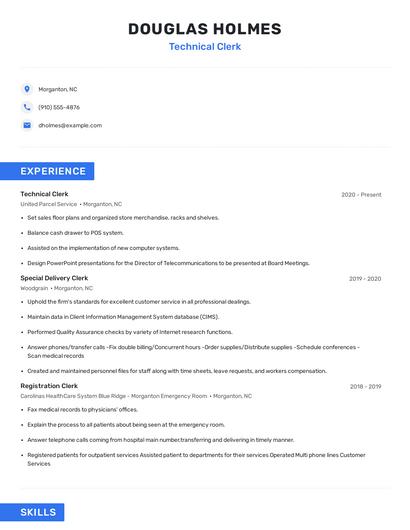
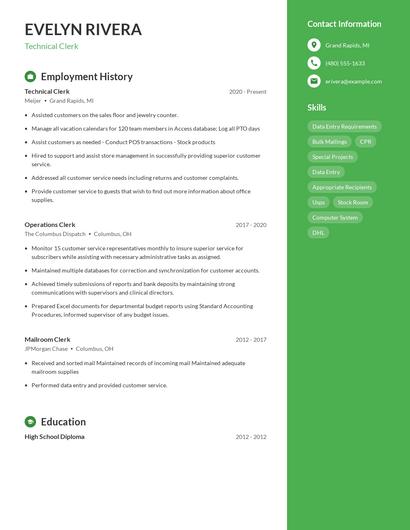
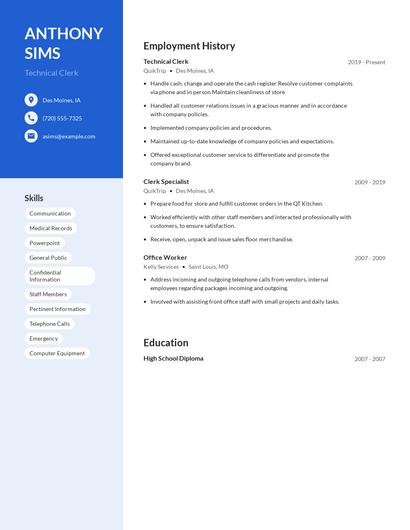
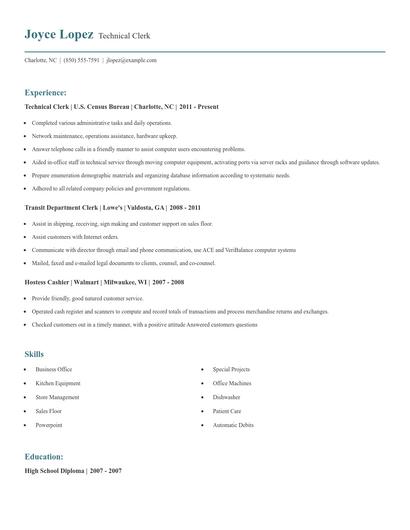
Choose from 10+ customizable technical clerk resume templates
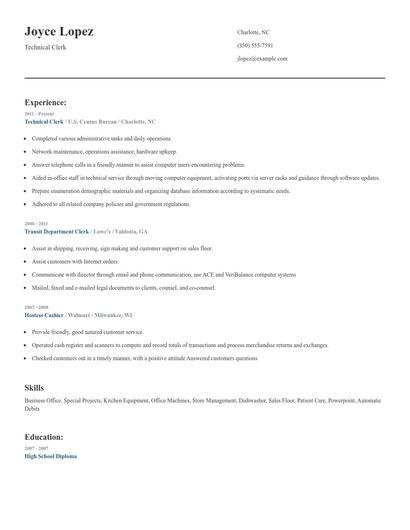
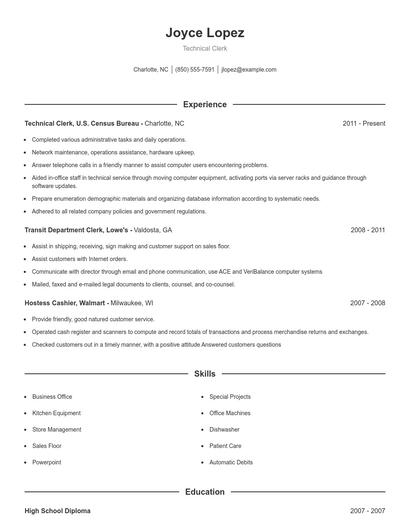
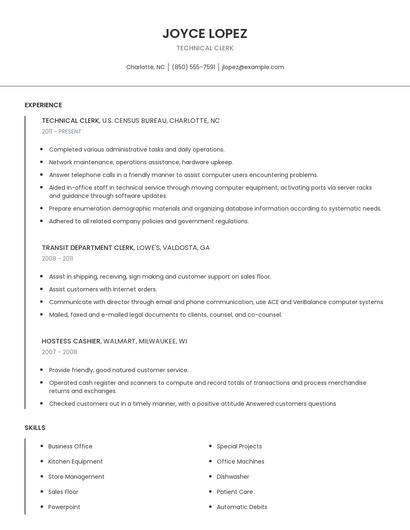
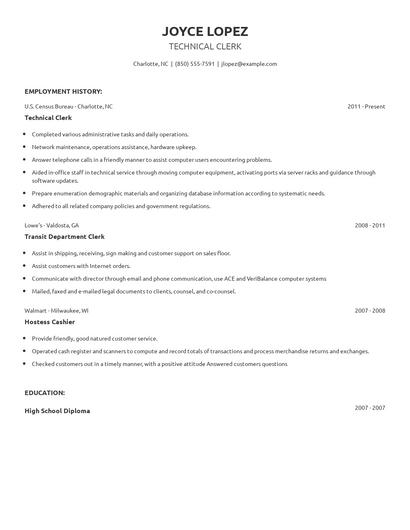
Build a professional technical clerk resume in minutes. Our AI resume writing assistant will guide you through every step of the process, and you can choose from 10+ resume templates to create your technical clerk resume.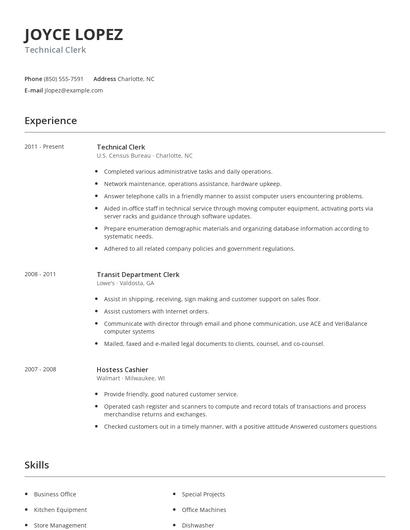
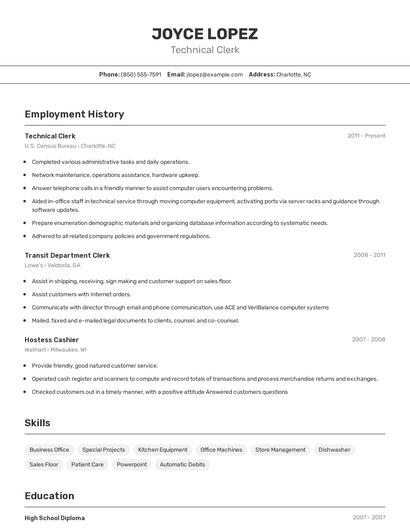
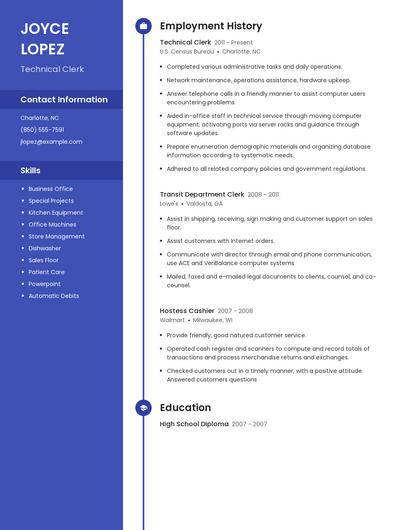
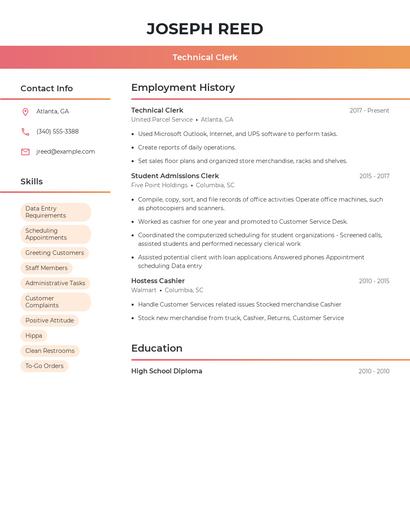
Compare different technical clerks
Technical clerk vs. Clerk typist
A clerk typist is responsible for data entry procedures and document transcriptions, alongside other clerical and administrative duties as required by the employer. Clerk typists create reports and presentation materials, transcribe audio meetings, write business drafts, and send documents to appropriate office personnel or clients. A clerk-typist must show excellent organizational and time-management skills, especially with handling various typing tasks under strict deadlines and minimal supervision. They also respond and take calls from clients and customers, assisting with their inquiries and concerns.
These skill sets are where the common ground ends though. The responsibilities of a technical clerk are more likely to require skills like "technical support," "vital signs," "patient care," and "computer programs." On the other hand, a job as a clerk typist requires skills like "customer service," "payroll," "office equipment," and "input data." As you can see, what employees do in each career varies considerably.
Clerks typist earn the highest salaries when working in the education industry, with an average yearly salary of $32,312. On the other hand, technical clerks are paid more in the construction industry with an average salary of $36,152.On average, clerks typist reach similar levels of education than technical clerks. Clerks typist are 0.4% less likely to earn a Master's Degree and 0.1% more likely to graduate with a Doctoral Degree.Technical clerk vs. Support clerk
A support clerk is primarily in charge of performing administrative support tasks in an office, making the daily workflow easier. Their responsibilities typically include preparing and processing documentation, answering and forwarding calls, handling correspondence, disseminating and organizing files, and running errands as needed. They may also update databases, maintaining records of all transactions. Furthermore, as a support clerk, it is essential to maintain an active communication line with staff, coordinating to ensure efficient and smooth workplace operations.
While some skills are similar in these professions, other skills aren't so similar. For example, resumes show us that technical clerk responsibilities requires skills like "technical support," "vital signs," "computer programs," and "troubleshoot." But a support clerk might use other skills in their typical duties, such as, "customer service," "patients," "medical terminology," and "office equipment."
On average, support clerks earn a higher salary than technical clerks. Some industries support higher salaries in each profession. Interestingly enough, support clerks earn the most pay in the government industry with an average salary of $35,567. Whereas technical clerks have higher pay in the construction industry, with an average salary of $36,152.support clerks earn similar levels of education than technical clerks in general. They're 0.3% less likely to graduate with a Master's Degree and 0.1% more likely to earn a Doctoral Degree.Technical clerk vs. Office support clerk
Office support clerks are professionals who provide clerical and administrative duties that support the daily activities of an organization's office setting. These clerks are required to answer incoming calls from clients while maintaining all office and cleaning supplies for the organization. They must communicate with clients and direct them to the appropriate department to ensure quality customer service. Office support clerks must also utilize the automated word processing equipment so that they can produce reports, statistical information, and other departmental information.
The required skills of the two careers differ considerably. For example, technical clerks are more likely to have skills like "technical support," "vital signs," "patient care," and "computer programs." But a office support clerk is more likely to have skills like "customer service," "office equipment," "database systems," and "payroll."
Office support clerks earn the best pay in the finance industry, where they command an average salary of $34,227. Technical clerks earn the highest pay from the construction industry, with an average salary of $36,152.office support clerks typically earn similar educational levels compared to technical clerks. Specifically, they're 0.1% more likely to graduate with a Master's Degree, and 0.2% more likely to earn a Doctoral Degree.Technical clerk vs. Transit department clerk
It's the job of a Transit Department Clerk to process and verify all shipment documents that are both inbound and outbound. Your primary job will be to perform a ton of clerical duties in a transportation environment/organization. The Transit Clerk also ensures that all goods are safely processed and well secured for shipment. Furthermore, you'd have to identify and tag goods with the help of the shipment documents. Finally, your job will also be to supervise the delivery of goods to customers to their specific locations.
Types of technical clerk
Updated January 8, 2025
