- HR Statistics
- Average Labor Cost Percent Of Sales
- Average Time to Reach Profitability At A Startup
- Office Space Per Employee
- Recruitment Statistics
- Employee Engagement Statistics
- Work-Life Balance Statistics
- BYOD Statistics
- Paternity Leave Statistics
- Onboarding Statistics
- Average Paid Maternity Leave In Us
- Average Cost Of A Bad Hire
- Employee Theft Statistics
- Paid Family Leave Statistics
- Cost Of Hiring Statistics
- Employee Turnover Statistics
- Average Cost Of Employer Sponsored Health Insurance Statistics
- Sexual Harassment In The Workplace Statistics
- HR Statistics
- PTO Statistics
- Social Media Recruitment Statistics
- Hiring Statistics
- Out Of Prison Employment Statistics
Research Summary. The conversation around paid maternity leave in the U.S. has highlighted its significant shortcomings compared to other nations. Despite progress, a large percentage of American workers still lack access to paid maternity leave, and the average leave duration remains limited when compared globally.
To better understand the landscape of maternity leave policies in the U.S., we’ve compiled key facts and statistics. Based on our thorough research:
-
23% of employees in private industries have access to paid maternity leave.
-
8 weeks is the average duration of paid maternity leave provided by companies, although this is not legally mandated. Federal law stipulates only 12 weeks of unpaid leave under the Family and Medical Leave Act (FMLA).
-
40% of employers offer some form of paid maternity leave.
-
70% of women take some type of maternity leave.
-
The average maternity leave duration in the U.S. is 10 weeks, inclusive of both paid and unpaid leave.
-
82% of Americans support the implementation of a federal paid maternity leave policy.
For additional insights, we have categorized the data as follows:
Unpaid vs. Paid | Industry | Company Size | Region
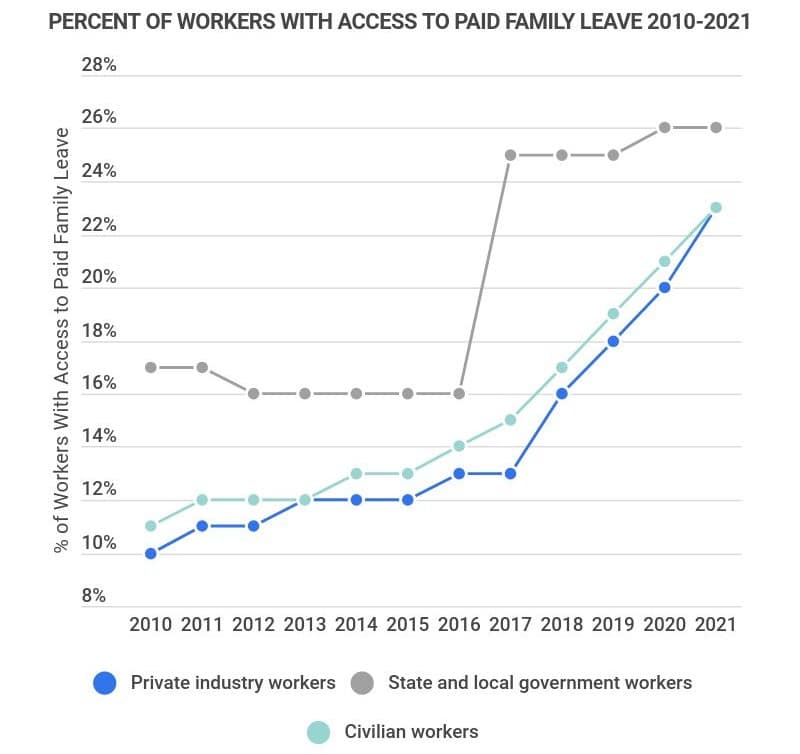
Percent of Workers With Access to Paid Family Leave 2008-2021
| Year | Private Industry Workers | State And Local Government Workers | Civilian Workers |
|---|---|---|---|
| 2021 | 23% | 26% | 23% |
| 2020 | 20% | 26% | 21% |
| 2019 | 18% | 25% | 19% |
| 2018 | 16% | 25% | 17% |
| 2017 | 13% | 25% | 15% |
| 2016 | 13% | 16% | 14% |
| 2015 | 12% | 16% | 13% |
| 2014 | 12% | 16% | 13% |
| 2013 | 12% | 16% | 12% |
| 2012 | 11% | 16% | 12% |
| 2011 | 11% | 17% | 12% |
| 2010 | 10% | 17% | 11% |
General Paid Maternity Leave Statistics
The U.S. significantly lags behind many countries regarding paid maternity leave. While the Family and Medical Leave Act (FMLA) of 1993 guarantees unpaid maternity leave, many argue that this is insufficient. Here are the latest insights:
-
The FMLA allows for 12 weeks of unpaid maternity leave, but eligibility criteria apply.
To qualify, employees must have been at their company for at least 12 months, logged 1,250 hours during that period, and work at locations with 50 or more employees within 75 miles.
In contrast, countries like North Korea offer women 240 days of unpaid maternity leave, illustrating a stark difference.
-
On average, paid maternity leave in OECD countries is 18 weeks.
This includes nations such as Canada, Australia, and most of Europe, making the U.S. the only OECD member without a mandatory paid maternity leave policy.
-
36 countries in Europe and Asia provide over 52 weeks of paid maternity leave, whereas the U.S. offers none.
Estonia leads with 84 weeks of paid leave, followed by Bulgaria (70 weeks), Hungary (68 weeks), and Lithuania (62 weeks), all of which mandate employer payment during this time.
-
More than 120 countries enforce paid maternity leave by law.
Most of these adhere to the International Labor Organization (ILO) guidance, which recommends 12-14 weeks. The U.S. is one of only 33 countries that provide less than 12 weeks of paid leave, with no mandatory paid maternity leave established.
-
The U.S. is one of just 7 countries globally that does not guarantee paid parental leave.
Alongside countries like Papua New Guinea and Micronesia, the U.S. stands out as the only affluent nation in this group.
Unpaid and Paid Maternity Leave Statistics
With the U.S. trailing behind other nations in paid maternity leave, how does this impact new mothers? The data reveals that many American mothers take less time off than recommended. Here are key findings from our research:
-
Only 25% of women take nine weeks or longer of maternity leave, whether paid or unpaid.
Due to the scarcity of paid maternity leave, many American mothers take significantly less than 12 weeks off. In fact, only 51% of women take 5 or more weeks of maternity leave.
-
One-third of U.S. women do not take maternity leave.
Surprisingly, one-third of new mothers either take no time off or return to work shortly after giving birth or adopting a child.
-
Lower-income women are 58% more likely to forgo maternity leave.
Among women earning less than $30,000 annually, 62% do not take maternity leave, while only 26% of those earning $75,000 or more opt out.
-
Experts advocate for at least 6 months to a year of paid maternity leave.
Despite this, current U.S. legislative proposals suggest only 12 weeks of paid maternity leave, facing considerable challenges in implementation.
-
Women and families lose an estimated $22.5 billion in wages annually due to the absence of mandatory paid maternity leave.
This translates to an average loss of about $9,578 in wages for individuals taking 12 weeks of unpaid leave, typically amounting to 58% of their quarterly income.
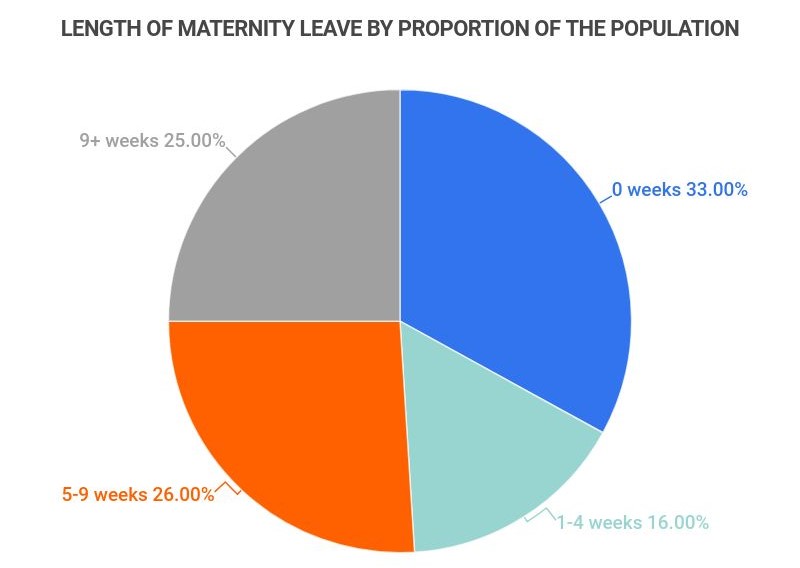
Length of Maternity Leave by Proportion of the Population
| Length Of Leave | Percentage Of New Moms |
|---|---|
| 0 weeks | 33% |
| 1-4 weeks | 16% |
| 5-9 weeks | 26% |
| 9+ weeks | 25% |
Paid Maternity Leave by Industry Statistics
While paid maternity leave can be scarce in the U.S., certain industries offer it more frequently. According to our findings:
-
The Architecture and Engineering sector includes 6 of the top 11 fields providing paid maternity leave.
Within this sector, the Senior Reliability Engineer position leads with 30% of job listings offering maternity leave, followed by the Lead Engineer role at 25%.
-
Food Preparation and Serving Related Occupations are the least likely to offer paid maternity leave.
Within this industry, no positions provide paid maternity leave. Most jobs in other sectors have at least a 1% chance of offering such benefits, but roles like cooks and servers have a 0% likelihood.
-
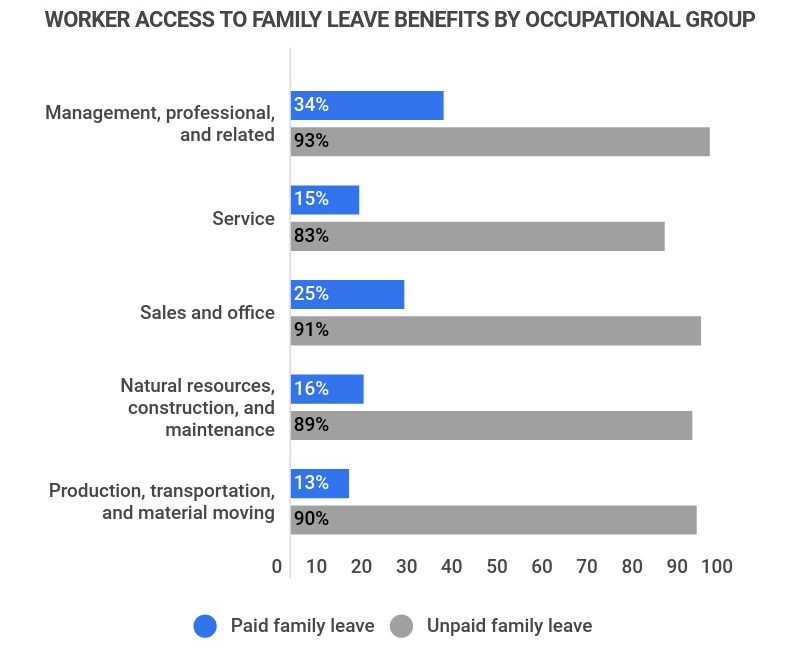
Management and professional roles have the highest access to paid family leave at 34%.
In contrast, production, transportation, and material moving jobs offer the lowest access at 13%. The service industry also sees a mere 83% access rate for unpaid family leave.
Jobs With the Highest Rate of Paid Maternity Leave
| Job | % of job listings |
|---|---|
| Senior Reliability Engineer | 30% |
| Lead Engineer | 25% |
| Electronics Technician | 20% |
| Senior Recruiter | 20% |
| Technical Support Engineer | 20% |
Jobs With the Lowest Rate of Paid Maternity Leave
| Job | % of job listings |
|---|---|
| Cook | 0% |
| Server | 0% |
| Sales Engineer | 1% |
| Case Manager | 1% |
| Architect | 1% |
Paid Maternity Leave by Company Size Statistics
Your employer’s size can significantly influence your access to paid maternity leave. Typically, federal employees enjoy greater access. Here are our findings:
-
Freddie Mac ranks as the top U.S. company for paid maternity leave, offering a full 12 weeks to its employees.
This government-sponsored mortgage corporation provides new mothers with 12 weeks of paid maternity leave and up to $30,000 to assist with adoption fees. Additionally, Freddie Mac has lactation support programs for breastfeeding mothers.
-
Only 15% of companies with 99 or fewer employees provide paid maternity leave.
Many of these smaller firms claim they struggle to compete with larger corporations. However, 70% of small businesses advocate for a national paid leave policy.
-
40% of private companies in the U.S. extend paid maternity leave.
Nonetheless, this does not guarantee that all employees have access to benefits; only 23% of private employees benefit from these programs on average.
-
2.1 million federal employees have access to paid maternity leave.
This accounts for approximately 70% of the federal workforce.
Paid Maternity Leave by Region Statistics
Due to the autonomy of states in the U.S., there can be considerable disparities in maternity leave policies across the country. For instance, states like Massachusetts and California offer more comprehensive paid maternity leave compared to states like Florida. Here are the current statistics on paid maternity leave by state:
-
As of 2020, Massachusetts offers the best paid maternity leave, providing up to 12 weeks of mandatory paid leave.
In 2019, Massachusetts enacted the Massachusetts Paid Family and Medical Leave Act (MA PFML), granting eligible employees up to 12 weeks of paid maternity leave, a policy mirrored by California.
-
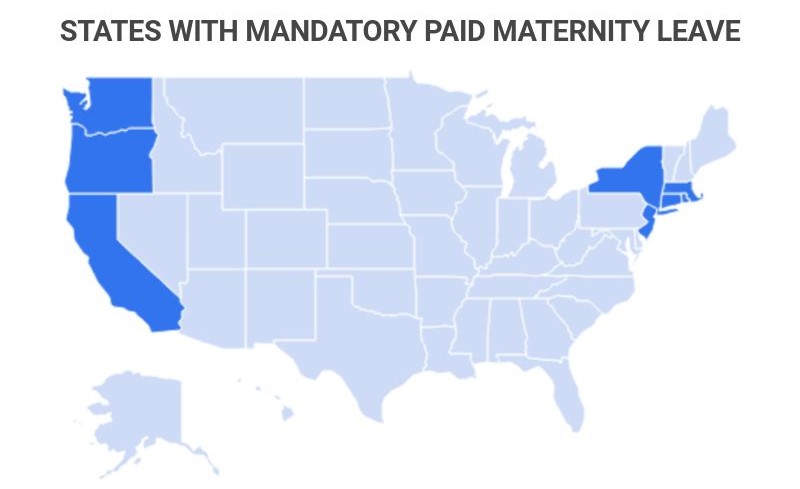
Only 8 states provide access to paid maternity leave.
These states include California, New Jersey, Massachusetts, Rhode Island, New York, Washington, Connecticut, and Oregon.
-
Louisiana ranks among the lowest for paid maternity leave, with 63% of workers lacking access.
This is primarily due to the absence of a state-mandated paid maternity leave policy and significant qualification loopholes.
Paid Maternity Leave FAQ
-
What is the average unpaid maternity leave?
The average unpaid maternity leave in the U.S. is 12 weeks. However, many new mothers choose to take less than 9 weeks due to the lack of paid leave options. For many, taking 12 weeks off without pay would be financially devastating.
-
How many U.S. companies offer paid maternity leave?
Approximately 40% of private companies in the U.S. provide paid maternity leave. This includes around 180 major companies with notable paid maternity leave policies, such as Amazon, Google, and Freddie Mac.
-
Is maternity leave paid in the U.S.?
No, maternity leave is typically not paid in the U.S. Currently, only 23% of private industry employees have access to paid maternity leave. The FMLA mandates 12 weeks of unpaid leave only.
While eight states have enacted paid maternity leave policies, and many federal employees benefit, the U.S. remains far behind other developed nations.
-
The FMLA, or Family and Medical Leave Act, was enacted in 1993 and provides 12 weeks of unpaid maternity leave for eligible employees.
To qualify, employees must have worked for the company for at least 12 months, logged 1,250 hours, and be at a location where 50 or more employees operate within 75 miles.
-
Can I get maternity leave if I just started a job?
Yes, you can receive maternity leave if you just started a job. However, the company is not legally obligated to provide it. To qualify for FMLA, you must have worked for at least one year or 1,250 hours with the employer.
The company must also have at least 50 employees within 75 miles. Companies are free to establish their parental leave policies, so you might be eligible for maternity leave shortly after starting.
-
Can you work another job while on maternity leave?
Yes, you can work another job during maternity leave. The FMLA does not prevent an employee from working for another employer while on their 12-week unpaid family leave.
However, companies may have policies that restrict outside employment during FMLA leave, which would still apply.
-
Can you be denied a job for being pregnant?
No, you cannot be denied a job due to pregnancy. The Pregnancy Discrimination Act of 1978 prohibits discrimination based on pregnancy or related conditions.
However, employers are not required to extend FMLA benefits to new hires.
-
What am I entitled to if I don’t return to work after maternity leave?
If you don’t return to work after maternity leave, you are entitled to pay for any unused paid time off and COBRA benefits. It is advisable to provide adequate notice regarding your decision not to return.
However, you may need to reimburse health insurance premiums used during your maternity leave unless you return to work for at least 30 days.
Conclusion
The U.S. remains considerably behind the 36 countries in Europe and Asia that provide over 52 weeks of paid maternity leave. The FMLA merely ensures 12 weeks of unpaid maternity leave, leaving the nation with a dire lack of federal paid maternity leave policies, affecting only 23% of private employees.
This absence of a national policy also creates significant disparities in access, particularly between private and federal employees, as well as among different states and companies. For example, Massachusetts mandates at least 12 weeks of paid maternity leave for eligible employees, while loopholes in Louisiana leave 63% of workers without access to maternity leave.
Fortunately, there is a positive trend emerging. Many of the eight states with mandatory paid leave policies were enacted within the past few years. Moreover, 70% of small businesses back a national paid leave policy, despite only 15% of their workforce currently having access.
With the introduction of more paid maternity leave policies, the U.S. may witness an increase in the number of individuals with access to these essential benefits.
Sources:
-
UCSF. “National Paid Maternity Leave Makes Sense for Mothers, Babies and Maybe the Economy.” Accessed on September 14th, 2021.
-
The Balance Careers. “How Long Is the Average Maternity Leave?” Accessed on September 14th, 2021.
-
U.S. Department of Labor. “Frequently Asked Questions and Answers About the Revisions to the Family and Medical Leave Act.” Accessed on September 14th, 2021.
-
Insider. “Here’s what maternity leave looks like around the world.” Accessed on September 14th, 2021.
-
PEO Worldwide. “Maternity and Paternity Pay Around the World.” Accessed on September 14th, 2021.
-
CNN. “Paid leave for parents: What’s the right amount of time?” Accessed on September 14th, 2021.
-
Center for American Progress. “The Rising Cost of Inaction on Work-Family Policies.” Accessed on September 14th, 2021.
-
Zippia. “The Best (and Worst) Jobs for Maternity Leave.” Accessed on September 15th, 2021.
-
Insider. “10 of the best companies for new parents, including Amazon, Microsoft, and Freddie Mac.” Accessed on September 15th, 2021.
-
HBR. “How Small Companies Can Offer Great Paid-Leave Programs.” Accessed on September 15th, 2021.
-
Talentculture. “60 Percent of U.S. Companies Still Don’t Offer Paid Paternity Leave.” Accessed on September 15th, 2021.
-
World Population Review. “Paid Maternity Leave By State 2021.” Accessed on September 15th, 2021.
-
CNBC. “These are the best and worst states for working moms in 2021, according to new report.” Accessed on September 15th, 2021.
-
BLS. “What data does the BLS publish on family leave?”. Accessed on January 6, 2022
- HR Statistics
- Average Labor Cost Percent Of Sales
- Average Time to Reach Profitability At A Startup
- Office Space Per Employee
- Recruitment Statistics
- Employee Engagement Statistics
- Work-Life Balance Statistics
- BYOD Statistics
- Paternity Leave Statistics
- Onboarding Statistics
- Average Paid Maternity Leave In Us
- Average Cost Of A Bad Hire
- Employee Theft Statistics
- Paid Family Leave Statistics
- Cost Of Hiring Statistics
- Employee Turnover Statistics
- Average Cost Of Employer Sponsored Health Insurance Statistics
- Sexual Harassment In The Workplace Statistics
- HR Statistics
- PTO Statistics
- Social Media Recruitment Statistics
- Hiring Statistics
- Out Of Prison Employment Statistics

Author

Chris Kolmar is a co-founder of Zippia and the editor-in-chief of the Zippia career advice blog. He has hired over 50 people in his career, been hired five times, and wants to help you land your next job. His research has been featured on the New York Times, Thrillist, VOX, The Atlantic, and a host of local news. More recently, he's been quoted on USA Today, BusinessInsider, and CNBC.