- Cover Letter Examples
- Cover Letter Examples
- Best Cover Letters
- Cover Letter For Internship
- General Cover Letter Templates
- Career Change Cover Letter
- Promotion Cover Letter
- College Student Cover Letter
- Entry Level Cover Letter
- Legal Cover Letter
- Creative Cover Letter
- Cover Letter For Government Job
- Cover Letter With No Experience
- Short Cover Letter Examples
- How To Send An Email Cover Letter
- How To Write A Cover Letter For A Job With No Experience In That Field
Find a Job You Really Want In
Summary. To write an effective career change cover letter, begin with a professional header that includes your information as well as that of the hiring manager. Always strive to find the hiring manager’s name for a personal touch; if that’s not possible, address it by their job title. Start your letter with a captivating opening line that grabs attention.
Though changing careers may seem daunting, it’s a common and strategic move in today’s evolving job market. The key lies in articulating your motivations for the transition, which your cover letter provides an excellent platform for.
This article will guide you through the process of crafting a compelling cover letter tailored for a career change, complete with examples you can adapt for your own use.
Key Takeaways
-
Your cover letter should be concise (200-400 words), so capture the reader’s attention and get to the point quickly.
-
Clearly explain both your reasons for leaving your previous career and your decision to pursue this new path in your cover letter.
-
Demonstrate your understanding of the position and the company you are applying to, and elaborate on why you would be a great fit.

How to Write a Career Change Cover Letter
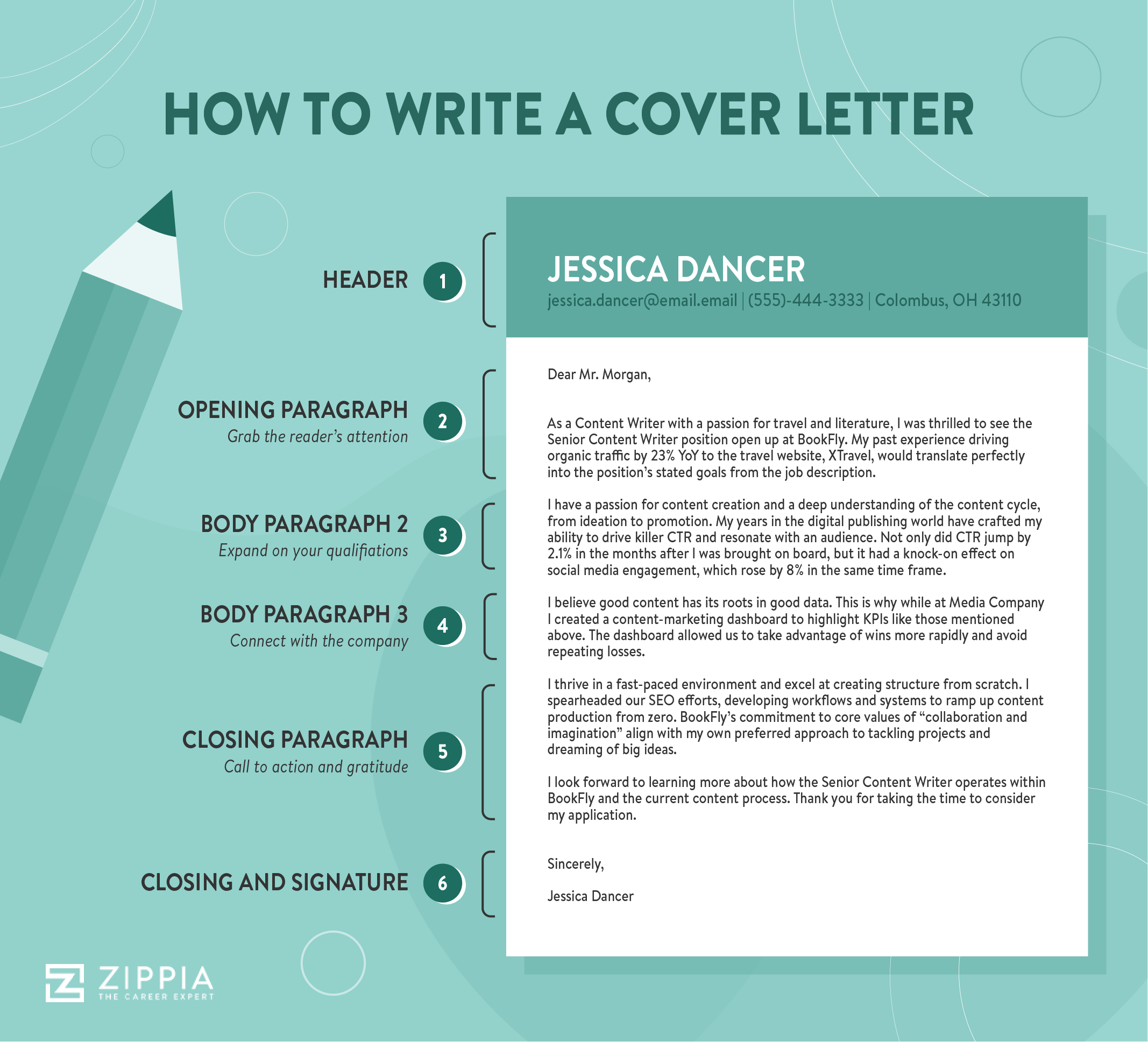
You’ve likely explored various cover letter examples and are searching for the perfect format. The good news is that effective cover letter templates share a similar structure. They should be formatted according to the conventional business letter layout.
Keep in mind that cover letters should be succinct; ideally, they should span about half a page and be composed of 200-400 words (shorter is usually better), organized into 3-4 paragraphs.
Essential sections of your cover letter include:
-
Header (only for printed copies)
-
Greeting
-
Opening paragraph
-
Body paragraph(s)
-
Closing lines
-
Sign-off and signature
Think of a cover letter as a means to market yourself to potential employers. This includes showcasing your qualifications, indicating that you’ve conducted company research, and detailing why you would excel in the new role.
Avoid crafting a generic cover letter; instead, focus on the specifics that will make your cover letter stand out:
Cover Letter Header
If you’re submitting a hard copy of your cover letter, start with a professional header. Include the following information:
[Your name]
[Your address]
[Phone number]
[Email][Current date]
[Hiring Manager name]
[Title]
[Company address]
Tom Timmins
34 Apple St., New York, NY
(555)-555-5555
Tom.Timmins@gmail.com4/28/2026
Sara Bilson
Director of Sales
New Company
55 New Road, New York, NY
Cover Letter Greeting
Always make an effort to identify the name of the hiring manager. Check the job posting, the company’s website, and their LinkedIn profile. If you’re unable to find the name online, consider calling the company to inquire about the appropriate contact for your cover letter.
If you can’t locate the hiring manager’s name, you may use “Dear Hiring Manager” or an alternative greeting.
Dear Ms. Tanner,
Dear Alix Sims,
Dear Software Engineer Hiring Team,
Cover Letter Opening Lines
Your opening line should be engaging while remaining relevant to the position. Consider sharing a relevant experience or expressing genuine enthusiasm for the role right away.
As a career changer, emphasize your transferable skills and experiences. For example, if transitioning from customer service to sales, your opening could look like this:
Helping customers have positive experiences has been my passion for over four years in customer service. With a proven record of high customer engagement and retention, I am excited to elevate my career by generating leads and sharing compelling opportunities as a Sales Representative for XYZ Corp.
Cover Letter Body Paragraph(s)
In the body paragraphs of your cover letter, demonstrate to recruiters that your skills extend beyond what’s immediately visible.
Highlight both your hard skills, such as certifications and technical proficiencies, and your soft skills, which are character traits like attention to detail, time management, and ability to thrive in high-pressure situations. Emphasize these soft skills, as they’re often not highlighted in your resume, and explain how they would be advantageous in the new role.
A helpful tip for identifying which transferable skills to focus on is to refer to the job description for specific keywords to include in your letter.
ABC Inc. seeks a Sales Representative who understands clients’ needs and can convey unique value propositions to build trust and credibility. During my time as a Customer Service Representative with XYZ Corp., I achieved a 99.7% positive customer review rate by providing exceptional client service. Additionally, I mentored new team members, helping to achieve corporate goals and quotas.
XYZ Corp. recognized my contributions by naming me “Customer Success Employee of the Month” in June 2025. I accomplished this by maintaining exceptional organizational skills to efficiently schedule calls, meetings, and appointments. When promoted to a supervisory role, I quickly adapted to new demands by aligning our team with management goals, resulting in a 17% reduction in customer wait times.
Notice how the candidate highlights past job performance while focusing on transferable skills and experiences. Candidates already in the industry may have specific examples of success in similar roles.
Even as you embark on a new career path, it’s important to discuss your past achievements. Whether you increased sales, gained client acquisitions, or received awards for meeting benchmarks, these concrete indicators of performance can translate into potential success in your new role.
Cover Letter Closing Lines
Your closing statement is just as crucial as your opening lines, as it’s what the reader will remember most clearly.
A strong way to conclude your cover letter is with a positive statement expressing your enthusiasm for the role and gratitude to the hiring manager for their time. A brief summary of your work history and a call to action are also effective to include.
Here’s an example of how this might look:
I believe I’d be an excellent fit for this role, and my customer service background would be invaluable as a Sales Representative. I look forward to discussing this opportunity further and sharing how my experience could benefit ABC Inc. Thank you for your time and consideration.
Cover Letter Sign-off and Signature
After concluding your letter, use a professional sign-off such as “Sincerely,” followed by your signature. Here’s what this looks like for a printed letter:
Sincerely,
[Your handwritten signature]
[Your typed name]
For an email or digital copy:
Sincerely,
[Your typed name]
[Your address]
[Your phone number]
[Your email address]
Career Change Cover Letter Example
Now that you have the fundamentals of writing cover letters down, it’s time to create your own. Review the professional cover letter examples below, but remember to personalize each one. Each cover letter should be tailored to the specific position you’re applying for.
[Your name]
[Your address]
[Phone number]
[Email][Current date]
[Hiring Manager name]
[Title]
[Company address]Dear Mr. Smith,
Over the past few months, I’ve had the rewarding experience of organizing community events for those facing financial hardships. Assisting those in need has sparked a passion in me for empowering communities, which is why I find the job requisition for Community Engagement Specialist at City of Lake County incredibly exciting.
While my previous experience is primarily in the sales industry, I believe my professional background is highly transferable to this new role. At Telco Sales Corp, I achieved the following:
Acquired 50 new partnerships in Q1 2026
Increased overall sales by 102% year-over-year
Maintained a 98% customer retention rate
As a Community Engagement Specialist, my goal would be to cultivate relationships and secure funding for community programs. My sales experience has proven my ability to build and maintain relationships while driving revenue. I received multiple awards during my tenure, including back-to-back Employee of the Year acknowledgments and Lead Customer Care Advocate.
I’m ready to make this career transition, having found my calling in bettering my community. My analytical and customer service skills, together with my planning and management capabilities, would make me an ideal Community Engagement Specialist with Lake County.
I appreciate your time in reviewing my qualifications and experiences, and I look forward to discussing this opportunity further.
Sincerely,
(Signature for printed letter)
[Your name]
Email Cover Letter Example
Email cover letters follow the same structure as traditional career change cover letters; however, there are specific considerations for execution.
Include your full name and the role you’re applying for in the email subject line. Some job postings will specify whether the cover letter should be sent as an email attachment or within the email body, so pay attention to those details.
If no specifications are provided, you can simply use the salutation (omit the preceding contact information typically included in a standard cover letter) and paste your letter directly into the email. Here’s a simple email career change cover letter sample:
Subject line: Sports Content Writer — [Your name]
Dear [Hiring manager name],
Nothing is more fulfilling than creating content that resonates with readers. Last year, I launched my sports blog and quickly discovered that what started as a hobby is my true passion. This realization is why the Sports Content Writer role at Sports Co. is the perfect career transition for me.Through my website, I averaged over 7,000 unique visitors monthly without any paid search campaigns. Additionally, I built a community of over 10,000 sports enthusiasts on Facebook, where readers actively engage and ask industry-related questions. My YouTube channel also has over 2,000 subscribers, consistently producing new videos weekly.
As a Regulatory Specialist, I reviewed a high volume of applications daily and ensured accuracy. This experience honed my skills as a proofreader, ensuring my content is publication-ready with minimal editing required. My achievements in this role include:
Maintaining a 100% accuracy rate on approved applications
Receiving multiple Processor of the Month awards for completing the most applications in a 30-day span
Being named Quality Assurance Lead for consistently proofing and sending over 100+ pieces of correspondence within a week
Sports Co. is dedicated to providing fun and engaging sports information to fans. Given that your site averages 100,000 views daily and is recognized as an authority in the sports industry, I believe my skills would contribute to enhancing overall readership. I also have experience writing about less mainstream sports like darts and pool, along with a comprehensive knowledge of various sports on my blog.
I feel that my ability to thrive in a fast-paced environment, experience producing high volumes of content, and extensive sports knowledge make me an ideal candidate for the Sports Content Writer position. Thank you for considering my qualifications, and I look forward to learning more about this opportunity.
Best,
[Your name]
[Address]
[Phone number]
[Email]
[LinkedIn Profile URL (optional)]
Tips for Writing a Career Change Cover Letter
-
Explain your motivation for the career change. This is a common question that any applicant seeking a new career may face in a job interview, so it’s beneficial to address it in your cover letter.
Employers typically want to understand why you left your last job, and transitioning careers often raises questions. Your reason could be a desire to explore something new in a post-pandemic job market. Maybe you have a friend in the industry and feel your skill set aligns more closely with a role similar to theirs.
There isn’t a right or wrong reason; just ensure you give the hiring manager insight into why you want this position despite your different background.
While I excel in customer service, I find I’m most engaged and perform at my best when I help a customer discover a new solution rather than just fixing a problem with their current product. When my supervisor mentioned that no customer service rep she managed achieved higher conversion rates than me, it resonated with me.
-
Demonstrate your passion for your new direction. This is your opportunity to shine and set yourself apart from other applicants. What excites you about the industry, and specifically this role?
Articulate your enthusiasm for this journey and why you would be a great fit for the team. Share the source of this passion to add a personal touch, and explain how this drive will contribute to your success in the role.
I thrive on helping customers find top-quality solutions while maintaining brand loyalty. I aspire to extend your company’s products and services to a broader audience because I believe there is no superior POS service than what you offer.
-
Prove your understanding of the company. Hiring managers seek candidates who have a genuine interest in their organization. Do you have personal motivations for wanting to join the company? Do they have a social impact team whose initiatives you admire?
Dive deeper and conduct thorough research. Show the recruiter how your values align with those of the company.
Start by visiting the company’s website, but also explore LinkedIn. Examine employee profiles, particularly those in roles similar to the one you’re applying for. You can gain valuable insights about a company from its employees beyond what’s available on the website.
I noticed your corporate motto, “Listen First,” resonates with me deeply. Sales, like customer service, centers around accurately identifying pain points and offering solutions that may not be immediately apparent to the customer. I make it a priority to allow clients to express their needs at the beginning of discussions, which informs my strategy for assisting them.
Career Change Cover Letter FAQ
-
How long should a career change cover letter be?
A career change cover letter should be about half a page or three to four paragraphs. Your letter should be between 200 and 400 words, making it important to be concise and direct.
-
How do you indicate that you are changing careers in a cover letter?
You should clarify your reasons for seeking a career change and show enthusiasm for your new direction when mentioning a career shift in a cover letter.
A potential employer will want to understand why you left your previous job and why you are leaving the field entirely. Clearly explaining your motivations will provide them with better context.
-
What should be avoided when writing a cover letter?
Avoid spelling and grammar errors in your cover letter. Such mistakes can come across as unprofessional. Additionally, steer clear of generic content; make sure to tailor your letter to each company you apply to and try to identify the recipient’s name.
Ask the Experts
How To Write A Career Change Cover Letter

Nicole Ozburn
Human Resources Director
While some elements are industry-specific, they can often be quickly learned due to similar experiences in other fields. For example, if transitioning from Human Resources to Marketing, I would emphasize my recruitment skills and how I have marketed positions in the past. It’s also crucial to explain the reason behind the career change. Whether due to economic shifts, the pandemic, or gaining additional skills through education, these factors can compel an employer to consider my resume.
How To Write A Career Change Cover Letter

Kevin Daniels
Owner and Lead Copywriter
Capturing the reader’s attention from the start is vital and has proven effective. You could even begin with a quote from a recognized expert in your desired field (or a famous figure) to set the tone for your letter. Additionally, using a bulleted format for the body of the letter can be eye-catching and provide structure for seamlessly adding tailored content as needed.
Highlighting transferable skills is crucial in transition cover letters (and resumes, as well). Consider searching for “Work Skills” and “Work Traits” online; this will yield many examples that can help you discern the difference and choose traits that resonate with your professional brand.
Also, remember to avoid including too much content unique to the industry you’re leaving.
Example:
In my 14-year career with Boeing Commercial Airplanes, I became a noted expert in DfX and APQP methodologies…
Better:
In over a decade of experience, I have achieved noteworthy SME status in Lean/Six Sigma and related compliance directives, delivering millions in recurring savings to the business…
This phrasing uses the universally applicable terms “Lean” and “Six Sigma,” which are relevant in any business or manufacturing context, rather than pigeonholing yourself into an Aerospace-centric view.
References
-
Harvard Extension School – Resume and Cover Letters
- Cover Letter Examples
- Cover Letter Examples
- Best Cover Letters
- Cover Letter For Internship
- General Cover Letter Templates
- Career Change Cover Letter
- Promotion Cover Letter
- College Student Cover Letter
- Entry Level Cover Letter
- Legal Cover Letter
- Creative Cover Letter
- Cover Letter For Government Job
- Cover Letter With No Experience
- Short Cover Letter Examples
- How To Send An Email Cover Letter
- How To Write A Cover Letter For A Job With No Experience In That Field

Author

Chris Kolmar is a co-founder of Zippia and the editor-in-chief of the Zippia career advice blog. He has hired over 50 people in his career, been hired five times, and wants to help you land your next job. His research has been featured on the New York Times, Thrillist, VOX, The Atlantic, and a host of local news. More recently, he's been quoted on USA Today, BusinessInsider, and CNBC.
Expert
Matt Warzel a President of a resume writing firm (MJW Careers, LLC) with 15+ years of recruitment, outplacement, career coaching and resume writing experience. Matt is also a Certified Professional Resume Writer (CPRW) and Certified Internet Recruiter (CIR) with a Bachelor of Science in Business Administration (Marketing Focus) from John Carroll University.