What does a dispute resolution analyst do?
The main job of a dispute resolution analyst involves the work of correspondence clerks. Dispute resolution analysts provide dispute resolution services to professional neutrals, personnel, and claimants. They develop and enforce dispute resolution acknowledgments. It is their job to maintain high quality with external and internal customers. Also, they facilitate communications with their external or internal stakeholders and customers.
Dispute resolution analyst responsibilities
Here are examples of responsibilities from real dispute resolution analyst resumes:
- Lead the requirement gathering effort from key customers for development of new JAVA applications and for troubleshooting customer issues.
- Perform data entry into PeopleSoft and process write off with resolution codes.
- Negotiate settlement offers with clients to prevent litigation and reduce costs associate with arbitration.
- Research corporate actions and security pricing using Bloomberg and bank websites to provide accurate information for processing within the database.
- Complete daily tally, communication logs, benefit updates, medical policy reviews and review policies and procedures using SharePoint applications.
- Process and log all OGC incoming and outgoing mail on a daily basis.
- Provide suggested edits and specific recommendations from OGC subject matter experts and return the correspondence to the originating program office.
- Follow PayPal guidelines to dispute process and pay out on disputes and claims.
- Decrease loss of revenue by identifying and resolving potentially fraudulent PayPal claims.
Dispute resolution analyst skills and personality traits
We calculated that 12% of Dispute Resolution Analysts are proficient in Dispute Resolution, Sound Decisions, and Data Entry. They’re also known for soft skills such as Analytical skills, Time-management skills, and Communication skills.
We break down the percentage of Dispute Resolution Analysts that have these skills listed on their resume here:
- Dispute Resolution, 12%
Contribute to the improvement of the dispute resolution process via structured analysis and timely identification of behavioral trends.
- Sound Decisions, 7%
Explained procedures and made sound decisions in order to maintain good customer relations with consumers and merchants.
- Data Entry, 7%
Provided administrative support such as data entry, faxing, scanning, and mail sorting.
- Quality Standards, 6%
Reviewed team member cases and client interactions to ensure compliance with department and Visa/MasterCard quality standards.
- Identify Trends, 5%
Perform root cause analysis on complaints to Medicare and for member grievance and appeals to identify trends and recommend process improvements.
- Federal Regulations, 4%
Determine resolution according to MasterCard/Visa rules and federal regulations, E & Z.
"dispute resolution," "sound decisions," and "data entry" are among the most common skills that dispute resolution analysts use at work. You can find even more dispute resolution analyst responsibilities below, including:
Analytical skills. To carry out their duties, the most important skill for a dispute resolution analyst to have is analytical skills. Their role and responsibilities require that "management analysts must be able to interpret information and use their findings to make proposals." Dispute resolution analysts often use analytical skills in their day-to-day job, as shown by this real resume: "resolved customer atm disputes, such as lost/stolen cards and theft, over the telephone input data into fnb system"
Time-management skills. Another soft skill that's essential for fulfilling dispute resolution analyst duties is time-management skills. The role rewards competence in this skill because "management analysts often work under tight deadlines and must use their time efficiently to complete projects on schedule." According to a dispute resolution analyst resume, here's how dispute resolution analysts can utilize time-management skills in their job responsibilities: "researched customer disputes under deadline procedures and retrieved customer charges on system. "
Communication skills. Another skill that relates to the job responsibilities of dispute resolution analysts is communication skills. This skill is critical to many everyday dispute resolution analyst duties, as "management analysts must be able to convey information clearly in both writing and speaking." This example from a resume shows how this skill is used: "maintained regular communication with credit unions and their cardholders regarding dispute resolution. "
Interpersonal skills. A big part of what dispute resolution analysts do relies on "interpersonal skills." You can see how essential it is to dispute resolution analyst responsibilities because "management analysts work with managers and other employees of the organizations for which they provide consulting services." Here's an example of how this skill is used from a resume that represents typical dispute resolution analyst tasks: "service incoming calls from travelers agents providing stellar interpersonal and customer service skills on each interaction. "
Problem-solving skills. Another crucial skill for a dispute resolution analyst to carry out their responsibilities is "problem-solving skills." A big part of what dispute resolution analysts relies on this skill, since "management analysts must be able to think creatively to solve clients’ problems." How this skill relates to dispute resolution analyst duties can be seen in an example from a dispute resolution analyst resume snippet: "resolved disputed charges on credit card accounts. "
The three companies that hire the most dispute resolution analysts are:
- CMA CGM2 dispute resolution analysts jobs
- Dow Jones2 dispute resolution analysts jobs
- Randstad North America, Inc.2 dispute resolution analysts jobs
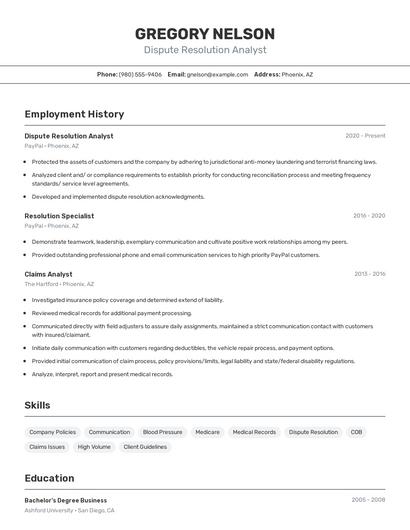
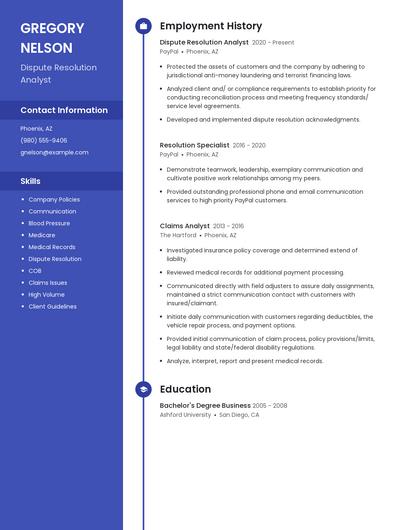
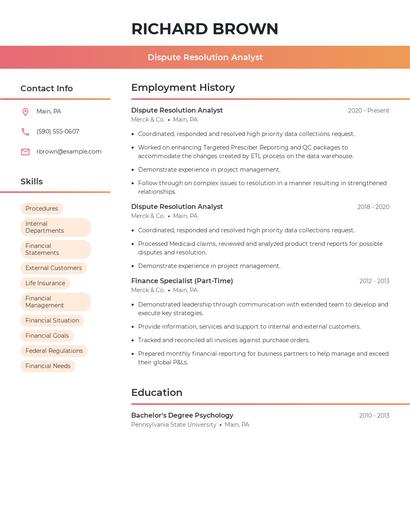
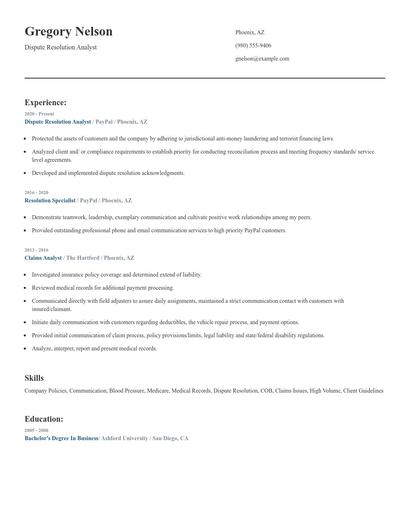
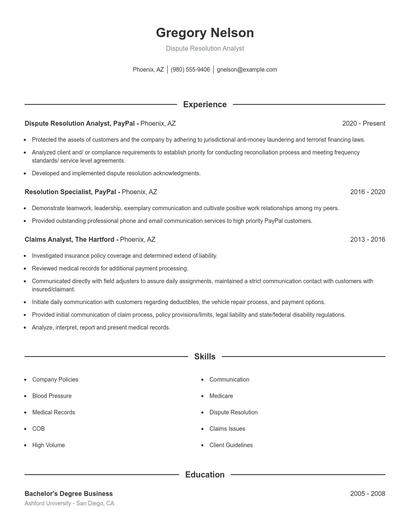
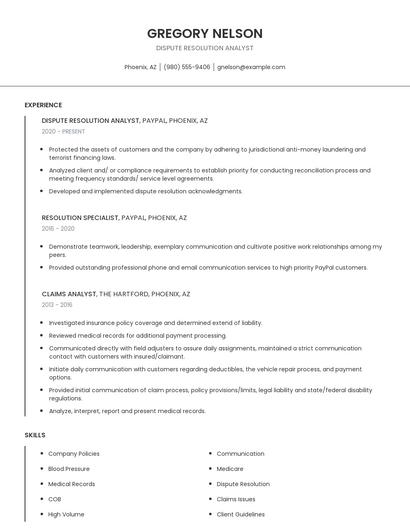
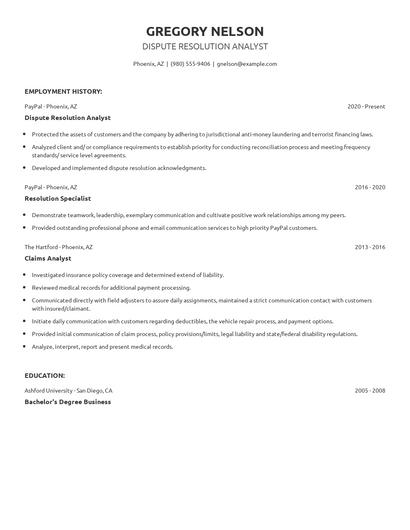
Choose from 10+ customizable dispute resolution analyst resume templates
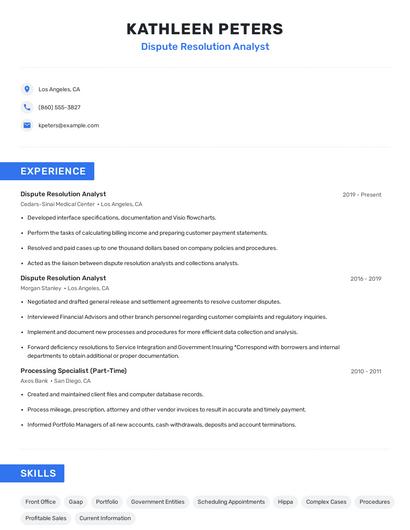
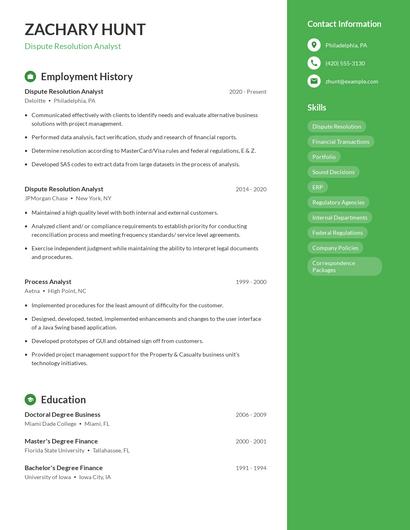
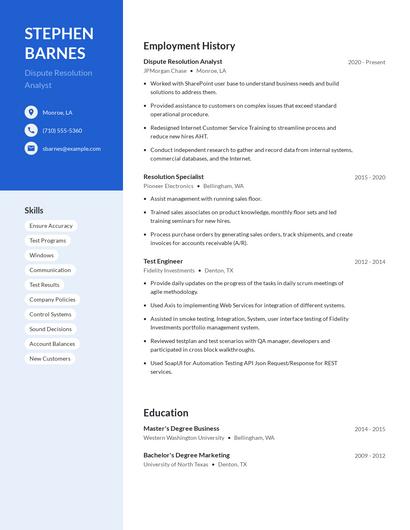
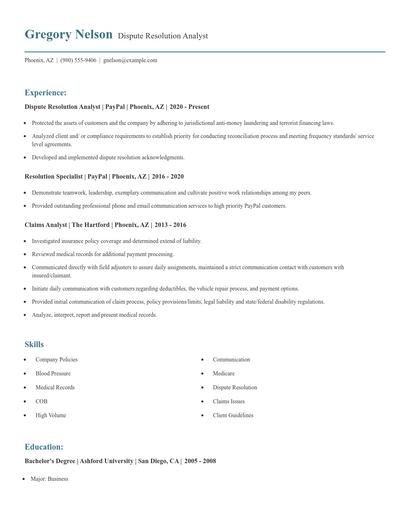
Build a professional dispute resolution analyst resume in minutes. Our AI resume writing assistant will guide you through every step of the process, and you can choose from 10+ resume templates to create your dispute resolution analyst resume.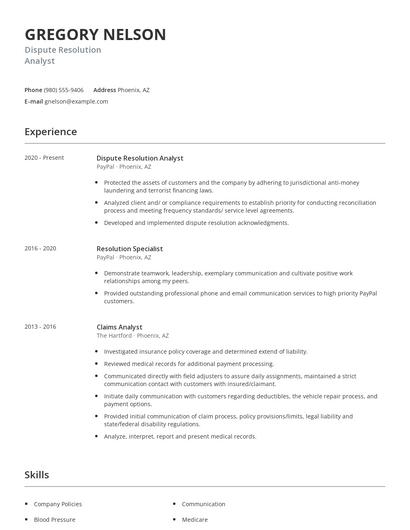
Compare different dispute resolution analysts
Dispute resolution analyst vs. Program management analyst
The job of a program management analyst involves optimizing business operations and analyzing organizational processes to increase productivity and maximize efficiency and profits. Program management analysts help track every company's schedule, budget, and delivery of goods and/or services. They prepare reports of the status of management projects. It is part of their job to determine business operations and opportunities. The analysts must develop skills in understanding long-term employer goals, management skills, and analytical skills.
While similarities exist, there are also some differences between dispute resolution analysts and program management analyst. For instance, dispute resolution analyst responsibilities require skills such as "dispute resolution," "sound decisions," "data entry," and "quality standards." Whereas a program management analyst is skilled in "program management," "project management," "program operations," and "management practices." This is part of what separates the two careers.
Program management analysts really shine in the technology industry with an average salary of $87,864. Comparatively, dispute resolution analysts tend to make the most money in the finance industry with an average salary of $73,311.On average, program management analysts reach higher levels of education than dispute resolution analysts. Program management analysts are 9.0% more likely to earn a Master's Degree and 0.1% less likely to graduate with a Doctoral Degree.Dispute resolution analyst vs. Management analyst
A management analyst is responsible for monitoring the efficiency and effectiveness of management operations, providing strategic advice and procedures to improve its services, and building excellent relationships with customers and business partners. Management analysts identify business opportunities that would help the business generate more revenues and meet long-term profitability goals. They develop techniques in maximizing productivity and optimization, recommending new systems, and upgrading existing processes. A management analyst must have excellent critical thinking and communication skills, especially when evaluating complex data and performance reports.
Each career also uses different skills, according to real dispute resolution analyst resumes. While dispute resolution analyst responsibilities can utilize skills like "dispute resolution," "sound decisions," "quality standards," and "identify trends," management analysts use skills like "customer service," "project management," "logistics," and "data analysis."
Management analysts earn a higher average salary than dispute resolution analysts. But management analysts earn the highest pay in the professional industry, with an average salary of $95,934. Additionally, dispute resolution analysts earn the highest salaries in the finance with average pay of $73,311 annually.management analysts earn higher levels of education than dispute resolution analysts in general. They're 6.4% more likely to graduate with a Master's Degree and 0.1% less likely to earn a Doctoral Degree.Dispute resolution analyst vs. Analyst
Analysts are employees or individual contributors with a vast experience in a particular field that help the organization address challenges. They help the organization improve processes, policies, and other operations protocol by studying the current processes in place and determining the effectiveness of those processes. They also research industry trends and data to make sound inferences and recommendations on what the company should do to improve their numbers. Analysts recommend business solutions and often help the organization roll out these solutions. They ensure that the proposed action plans are effective and produce the desired results.
There are many key differences between these two careers, including some of the skills required to perform responsibilities within each role. For example, a dispute resolution analyst is likely to be skilled in "dispute resolution," "sound decisions," "quality standards," and "identify trends," while a typical analyst is skilled in "customer service," "troubleshoot," "data analysis," and "management system."
Analysts earn the highest salary when working in the technology industry, where they receive an average salary of $79,330. Comparatively, dispute resolution analysts have the highest earning potential in the finance industry, with an average salary of $73,311.Most analysts achieve a similar degree level compared to dispute resolution analysts. For example, they're 2.8% more likely to graduate with a Master's Degree, and 0.8% more likely to earn a Doctoral Degree.Dispute resolution analyst vs. Program analyst
The job of program analysts is to plan, manage, and evaluate a company's computer programs. They usually perform different tasks, including researching and analyzing complex data to identify trends and offer the best recommendations for improvements. Other duties for this position may include creating policies and procedures, monitoring and evaluating program performance, and resolving any issues. This role's skills and requirements include a bachelor's degree in computer science, business, or related field. Previous work experience as a program analyst and critical thinking skills are also valued.
Types of dispute resolution analyst
Updated January 8, 2025
