What does a source recruiter do?
A source recruiter is responsible for reaching out to potential candidates to fill-in company job vacancies by evaluating the hiring department's requirements and qualifications. Source recruiters exhaust digital media platforms and online job boards to post staffing needs and filter applicants' proposals. They communicate with the applicants and schedule them for interviews and assessments for recommendation to the hiring manager. A source recruiter assists the successful candidates in processing requirements and informing them of onboarding procedures.
Source recruiter responsibilities
Here are examples of responsibilities from real source recruiter resumes:
- Manage internal transfer requisitions utilizing Taleo.
- Manage compensation packages using payroll software.
- Track candidates through company ATS (iCIMS )
- Update and maintain candidates in CRM and ATS.
- Utilize the ATS to insure OFCCP compliance in applicant tracking and processing.
- Source candidates using internal ATS, various job boards, universities, and job fairs.
- Utilize Taleo for additional financial services positions.
- Present and prepare PowerPoint presentations on various topics to educate colleagues in the office and operate WebEx technology for conference calls.
- Collaborate with corporate payroll for initial setup and employee maintenance.
Source recruiter skills and personality traits
We calculated that 15% of Source Recruiters are proficient in Customer Service, HR, and Applicant Tracking Systems. They’re also known for soft skills such as Communication skills, Detail oriented, and Interpersonal skills.
We break down the percentage of Source Recruiters that have these skills listed on their resume here:
- Customer Service, 15%
Received and made calls to individuals interested in hospitality and customer service.
- HR, 14%
Provided research to upper management about various aspects of HR function (diversity/relocation/outsourcing).
- Applicant Tracking Systems, 10%
Provided training for location staff on applicant tracking systems and background checking systems, as well as supporting retention efforts.
- Cloud, 5%
Provided candidate generation for Cloud Computing Services.
- Client Facing, 4%
Reviewed resumes and interviewed all candidates presented for detailed interviewing by the Client Facing Recruiter.
- Phone Screens, 4%
Conduct technical phone screens, digital assessments, and prepped candidates for interviews while collaborating with internal customers and corporate stakeholders.
Common skills that a source recruiter uses to do their job include "customer service," "hr," and "applicant tracking systems." You can find details on the most important source recruiter responsibilities below.
Communication skills. One of the key soft skills for a source recruiter to have is communication skills. You can see how this relates to what source recruiters do because "listening and speaking skills are essential for human resources specialists." Additionally, a source recruiter resume shows how source recruiters use communication skills: "ensured all communication and interview notes are documented in ats. "
Detail oriented. Many source recruiter duties rely on detail oriented. "specialists must pay attention to detail when evaluating applicants’ qualifications, doing background checks, maintaining records of an employee grievance, and ensuring that a workplace complies with labor standards.," so a source recruiter will need this skill often in their role. This resume example is just one of many ways source recruiter responsibilities rely on detail oriented: "performed detailed reference checks and/or reference analysis on selected candidates. "
Interpersonal skills. Another skill that relates to the job responsibilities of source recruiters is interpersonal skills. This skill is critical to many everyday source recruiter duties, as "specialists continually interact with others and must be able to converse and connect with people from varied backgrounds." This example from a resume shows how this skill is used: "display strong customer service, interpersonal, written and verbal communication skills daily in an effort to support organizational goals. "
The three companies that hire the most source recruiters are:
- Amazon115 source recruiters jobs
- McKinsey & Company Inc25 source recruiters jobs
- IntelliPro10 source recruiters jobs
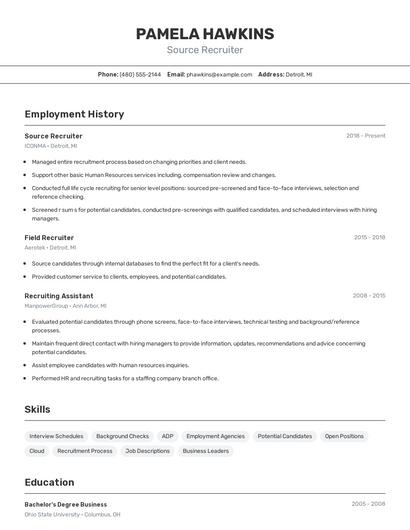
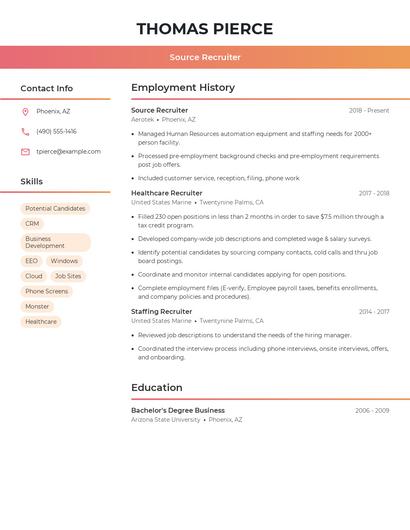
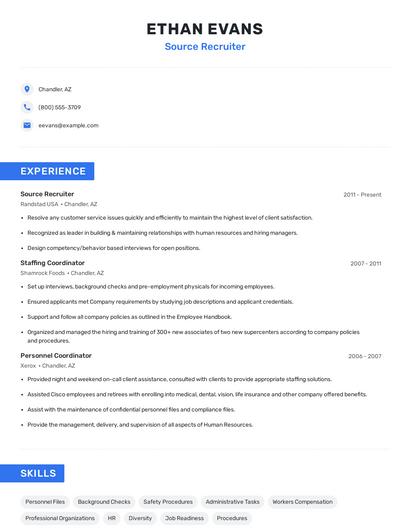
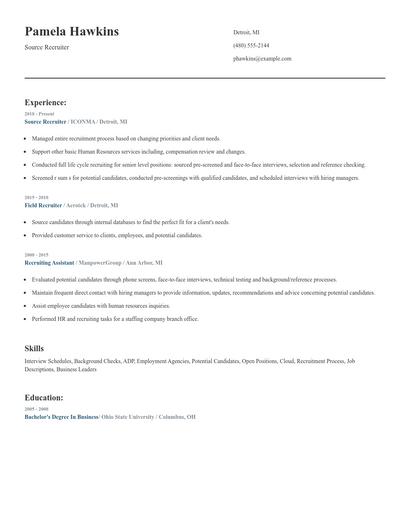
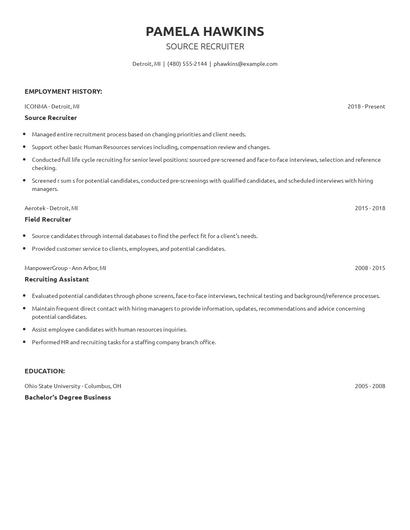
Choose from 10+ customizable source recruiter resume templates
Build a professional source recruiter resume in minutes. Our AI resume writing assistant will guide you through every step of the process, and you can choose from 10+ resume templates to create your source recruiter resume.





Compare different source recruiters
Source recruiter vs. Talent acquisition consultant
A Talent Acquisition Consultant is responsible for sourcing and recruiting high-quality candidates. They may work in an office setting or travel to different locations to search for new talents.
There are some key differences in the responsibilities of each position. For example, source recruiter responsibilities require skills like "hr," "cloud," "cloud computing," and "google+." Meanwhile a typical talent acquisition consultant has skills in areas such as "human resources," "manufacturing industry," "recruitment strategies," and "eeo." This difference in skills reveals the differences in what each career does.
Talent acquisition consultants tend to make the most money working in the finance industry, where they earn an average salary of $74,599. In contrast, source recruiters make the biggest average salary, $80,930, in the technology industry.The education levels that talent acquisition consultants earn slightly differ from source recruiters. In particular, talent acquisition consultants are 3.2% more likely to graduate with a Master's Degree than a source recruiter. Additionally, they're 0.3% more likely to earn a Doctoral Degree.Source recruiter vs. Staffing consultant
A staffing consultant develops and maintains the accounts of clients through outside and inside organizational activities. Staffing consultants induct, assess, and monitor the job applicants preparing them for their assignments. They match jobs to applicants and the candidates to their jobs. Their duties include helping both employees and employers in their respective responsibilities. They also act as business development and sales consultant to talent acquisition firms.
In addition to the difference in salary, there are some other key differences worth noting. For example, source recruiter responsibilities are more likely to require skills like "customer service," "hr," "cloud," and "client facing." Meanwhile, a staffing consultant has duties that require skills in areas such as "r," "direct hire," "criminal background checks," and "human resources." These differences highlight just how different the day-to-day in each role looks.
Staffing consultants earn similar levels of education than source recruiters in general. They're 2.4% less likely to graduate with a Master's Degree and 0.3% less likely to earn a Doctoral Degree.Source recruiter vs. Staffing specialist
A staffing specialist is responsible for overseeing the staffing needs of an organization. Staffing specialists work closely with the department heads and hiring managers for their staffing requirements and qualifications. They advertise job hirings on the company's online job board and other communication platforms. A staffing specialist carefully evaluates the applicants' documents, reaching out to potential candidates for scheduling interviews and assessments. A staffing specialist must have excellent knowledge of the human resources disciplines, following the policies and procedures of hiring candidates, and assist them during onboarding.
The required skills of the two careers differ considerably. For example, source recruiters are more likely to have skills like "hr," "cloud," "client facing," and "source candidates." But a staffing specialist is more likely to have skills like "human resources," "data entry," "telemarketing," and "persuasion."
Staffing specialists earn the highest salary when working in the health care industry, where they receive an average salary of $41,631. Comparatively, source recruiters have the highest earning potential in the technology industry, with an average salary of $80,930.staffing specialists typically earn similar educational levels compared to source recruiters. Specifically, they're 2.7% less likely to graduate with a Master's Degree, and 0.3% less likely to earn a Doctoral Degree.Source recruiter vs. Human resources generalist
A human resources generalist is responsible for monitoring the human resources policies and procedures, making adjustments as needed to align with the company's goals and objectives. Duties of a human resources generalist also include improving employee relations system, organizing compliance and knowledge training, reviewing benefit plans, managing compensation inquiries, assisting in recruitment and staffing needs, communicating with department heads in employees' performance reviews, and storing employees' files for reference. A human resource generalist must have excellent communication and decision-making skills to address issues concerning the company and employees' welfare.
Types of source recruiter
Updated January 8, 2025
