What does a tooling manager do?
A tooling manager is primarily responsible for overseeing information and data regarding tool systems. Although the extent of their responsibilities depends on their industry or place of employment, it typically includes setting objectives and guidelines, coordinating with staff to gather and analyze data, liaising with internal and external parties, tracking tool locations, and maintaining records. Moreover, a tooling manager typically works in a team setting, which requires an active communication line for a smooth and efficient workflow.
Tooling manager responsibilities
Here are examples of responsibilities from real tooling manager resumes:
- Manage fastener development and prototyping, and work to reduce cost across large part of fastener commodities.
- Lead JSA prior to picking up tools to run in wellbore and to pulling out wellbore and laying down tools.
- Supervise fishing operations and manage rig controls and risk analyses.
- Manage daily operations of precision machining facility that produces components for the medical and aerospace industry.
- Manage workflow and oversee strict cleanroom operations, assuring compliance with FDA specifications including labeling and packaging traceability.
- Perform many duties including, manual machining, operation of CNC mills, lathes, sinker and wire EDM's.
- Attend JSA meetings and ensure compliance with safety policies.
- Schedule overtime daily and weekly as per the operating agreement per the UAW contract.
- Conceptualize, design and develop, robotic work cells to produce new product formats.
- Maintain communication with client well site representative, rig crew, and field support staff.
- Develop and maintain all SPC capabilities records on new tooling and equipment using MiniTab software.
- Design and build machine tools, jigs, and fixtures for use in repetitive manufacturing environment.
- Design and build progressive, compound, form and secondary dies and prototype tools and parts.
- Coordinate new product launches with customers, prototype vendors, and tooling vendors throughout Ohio and Michigan.
- Conduct safety training and perform QA checks after maintenance work to contribute to outstanding plant safety record.
Tooling manager skills and personality traits
We calculated that 21% of Tooling Managers are proficient in Project Management, Continuous Improvement, and CNC. They’re also known for soft skills such as Speaking skills, Writing skills, and Creativity.
We break down the percentage of Tooling Managers that have these skills listed on their resume here:
- Project Management, 21%
Worked with development staff to improve project management techniques and identify needed process improvements.
- Continuous Improvement, 9%
Work directly with purchasing and other areas of the business to develop sourcing strategies and identify continuous improvements opportunities.
- CNC, 5%
Maintained and repaired conventional and CNC equipment Managed inventory.
- CAD, 5%
Demand CAD data and IGES files are delivered and checked before payment of tooling is made.
- Preventative Maintenance, 5%
Developed and implemented company preventative maintenance program for approximately 90 dedicated molds to correct error rates and improved manufacturing quality.
- Process Improvement, 5%
Represent software engineering discipline in all process improvement efforts and coordinate these process improvement initiatives with Software Engineering Management.
"project management," "continuous improvement," and "cnc" are among the most common skills that tooling managers use at work. You can find even more tooling manager responsibilities below, including:
Speaking skills. One of the key soft skills for a tooling manager to have is speaking skills. You can see how this relates to what tooling managers do because "industrial engineers sometimes have to explain their instructions to production staff or technicians before they can make written instructions available." Additionally, a tooling manager resume shows how tooling managers use speaking skills: "represented prototype products in assessment of twenty tool transfer program in china. "
Writing skills. Another essential skill to perform tooling manager duties is writing skills. Tooling managers responsibilities require that "industrial engineers must prepare documentation for other engineers or scientists, or for future reference." Tooling managers also use writing skills in their role according to a real resume snippet: "performed as leader in writing ppap package for new production parts. "
Creativity. Another skill that relates to the job responsibilities of tooling managers is creativity. This skill is critical to many everyday tooling manager duties, as "industrial engineers use creativity and ingenuity to design new production processes in many kinds of settings in order to reduce the use of material resources, time, or labor while accomplishing the same goal." This example from a resume shows how this skill is used: "standardized components, stock, and inventory cabinets resulting in 10% cost reduction. "
Problem-solving skills. tooling manager responsibilities often require "problem-solving skills." The duties that rely on this skill are shown by the fact that "in designing facilities for manufacturing and processes for providing services, these engineers deal with several issues at once, from workers’ safety to quality assurance." This resume example shows what tooling managers do with problem-solving skills on a typical day: "developed a continuous integration and test automation solution for nokia mobile phones platform software projects. "
The three companies that hire the most tooling managers are:
- Meta50 tooling managers jobs
- Wolters Kluwer13 tooling managers jobs
- Amazon5 tooling managers jobs
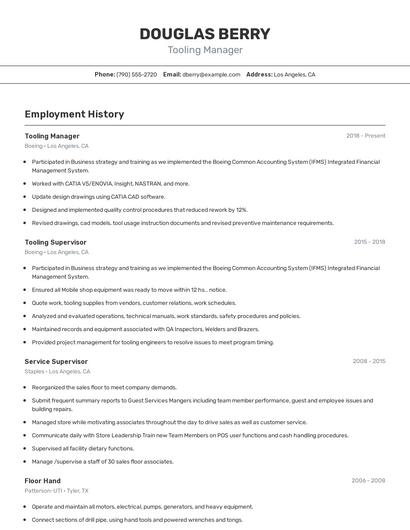
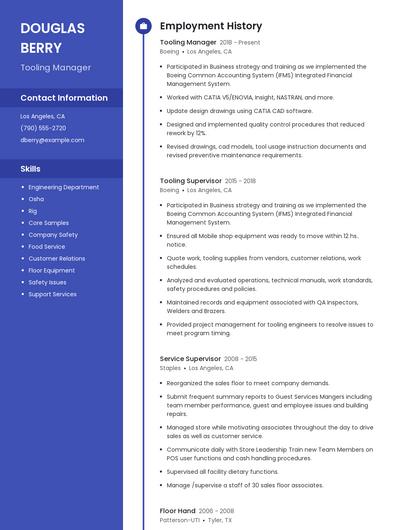
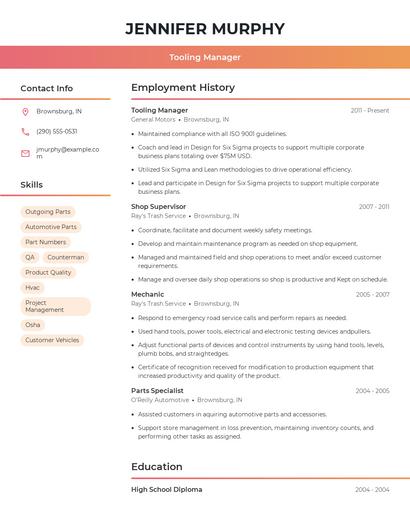
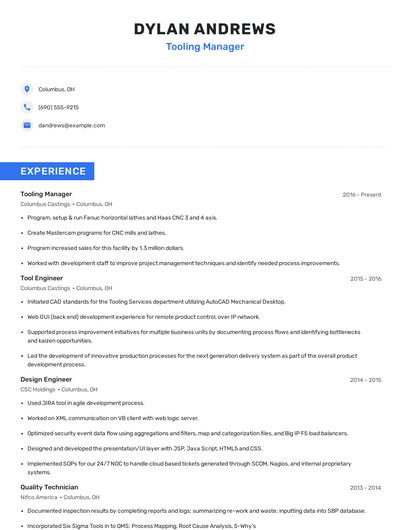
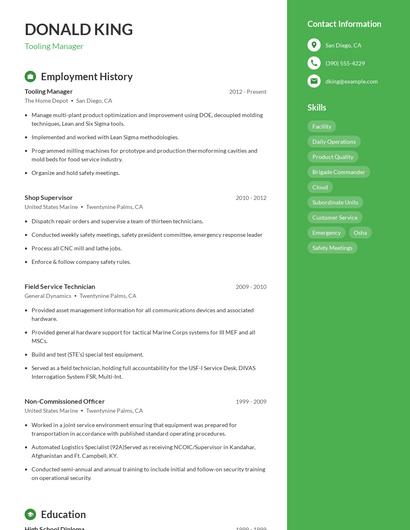
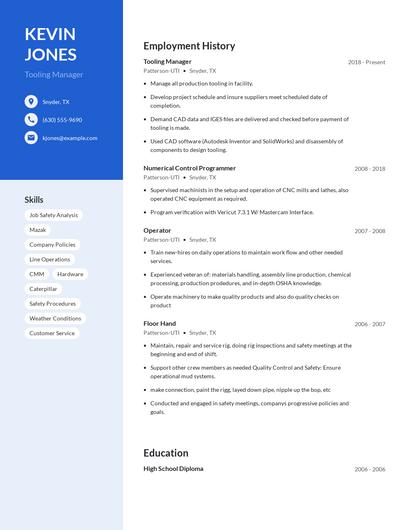
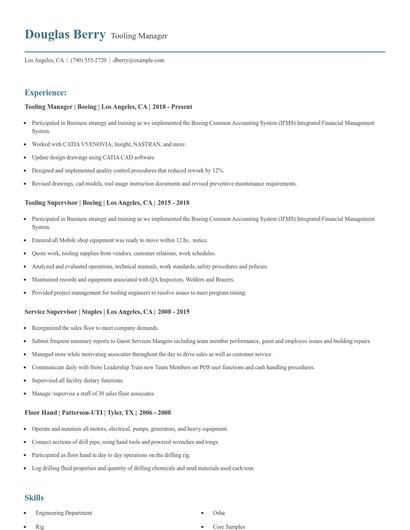
Choose from 10+ customizable tooling manager resume templates
Build a professional tooling manager resume in minutes. Our AI resume writing assistant will guide you through every step of the process, and you can choose from 10+ resume templates to create your tooling manager resume.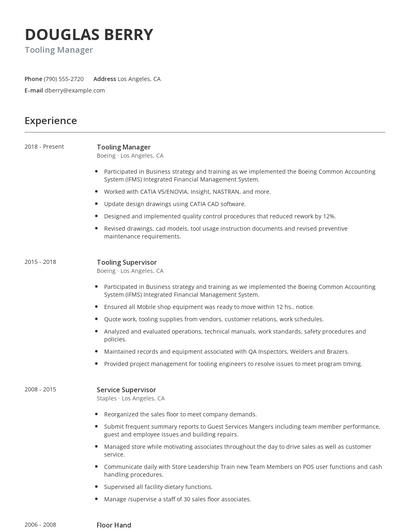
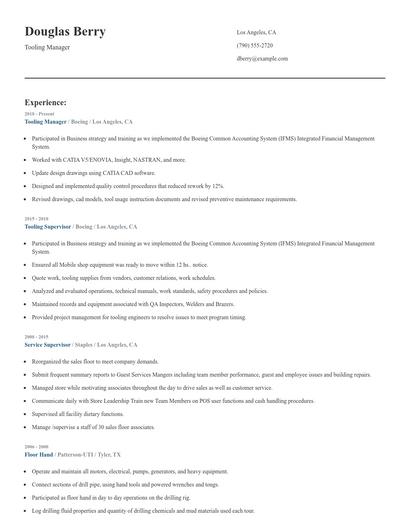
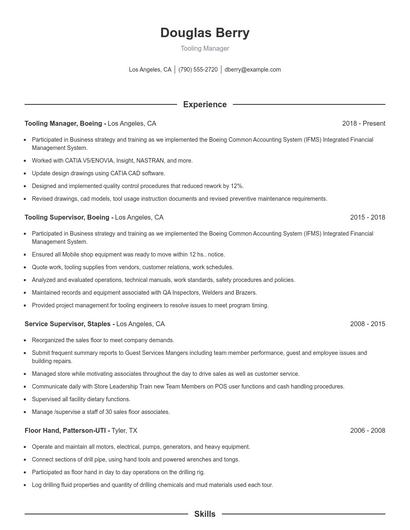
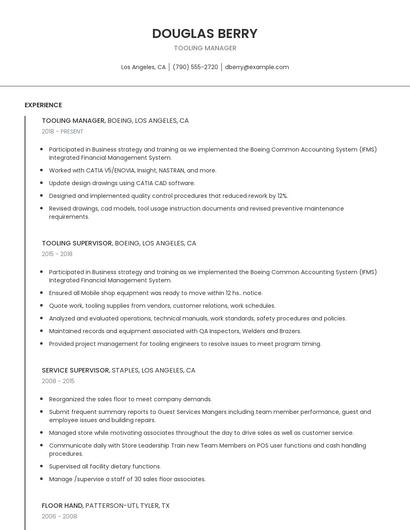
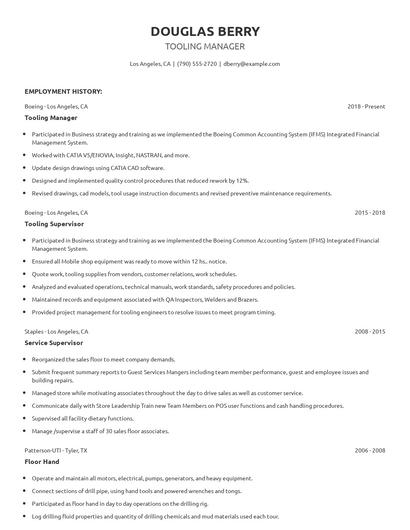
Compare different tooling managers
Tooling manager vs. Operations team leader
An operations team leader is an individual who manages teams, encouraging cooperation, productivity, and teamwork. Operations team leaders foster team unity and enhance the daily efficiency of the companies or any business establishment. They manage a diverse workforce in companies to make sure that the organizational operations are efficient. Also, they implement programs and processes and oversee building maintenance. It is also their responsibility to manage mechanical and human resources and establish a team budget.
While similarities exist, there are also some differences between tooling managers and operations team leader. For instance, tooling manager responsibilities require skills such as "cad," "java," "machine shop," and "management system." Whereas a operations team leader is skilled in "customer service," "excellent interpersonal," "sales floor," and "safety procedures." This is part of what separates the two careers.
Operations team leaders tend to reach similar levels of education than tooling managers. In fact, operations team leaders are 1.3% more likely to graduate with a Master's Degree and 0.2% more likely to have a Doctoral Degree.Tooling manager vs. Operation supervisor
Operations supervisors manage a specific operations-related team or department. They ensure that all the agreed-upon key performance indicators are being met. They also address any performance challenges and strategize on how to improve different areas in the team. They communicate team goals and balance the organization's requirements with the team's profile. Operations supervisors also manage the employees under their department. They hire for vacancies and train new employees. They also ensure that employees are properly coached for improvement. Operations supervisors are expected to be strategic, personable, and good communicators.
In addition to the difference in salary, there are some other key differences worth noting. For example, tooling manager responsibilities are more likely to require skills like "project management," "cnc," "cad," and "preventative maintenance." Meanwhile, an operation supervisor has duties that require skills in areas such as "logistics," "safety procedures," "osha," and "payroll." These differences highlight just how different the day-to-day in each role looks.
Operation supervisors earn a lower average salary than tooling managers. But operation supervisors earn the highest pay in the finance industry, with an average salary of $66,587. Additionally, tooling managers earn the highest salaries in the automotive with average pay of $117,277 annually.In general, operation supervisors achieve similar levels of education than tooling managers. They're 0.1% less likely to obtain a Master's Degree while being 0.2% more likely to earn a Doctoral Degree.Tooling manager vs. Supervisor
Supervisors are responsible for overseeing the daily functions of employees in a specific team, department, or even a work shift. They create work schedules, organize work processes and workflows, train new hires, provide necessary reports related to the team function and the employees, monitor and evaluate employee performance, and ensure that goals of the specific team or department are met. When needed, supervisors also provide guidance to employees in terms of their career or even personal challenges. They also help in fostering harmonious work relationships by resolving interpersonal conflicts at work. To be successful in their role, they must have leadership skills, time management skills, decision-making capabilities, analytical skills, and problem-solving skills.
Some important key differences between the two careers include a few of the skills necessary to fulfill the responsibilities of each. Some examples from tooling manager resumes include skills like "project management," "continuous improvement," "cnc," and "cad," whereas a supervisor is more likely to list skills in "customer service," "safety procedures," "sales floor," and "pos. "
Supervisors make a very good living in the health care industry with an average annual salary of $60,088. On the other hand, tooling managers are paid the highest salary in the automotive industry, with average annual pay of $117,277.When it comes to education, supervisors tend to earn similar degree levels compared to tooling managers. In fact, they're 0.3% less likely to earn a Master's Degree, and 0.5% less likely to graduate with a Doctoral Degree.Tooling manager vs. Lead supervisor
Lead supervisors are responsible for several duties within an organization. They are accountable for overseeing their members and making sure that the work they produce is of good quality. They mainly serve as role models for their staff members, who often seek guidance, leadership, and support from them. When issues arise between employees, lead supervisors should intervene by providing conflict management to ease the situation. They also have to delegate work to employees to get the job done efficiently.
Even though a few skill sets overlap between tooling managers and lead supervisors, there are some differences that are important to note. For one, a tooling manager might have more use for skills like "project management," "cnc," "cad," and "process improvement." Meanwhile, some responsibilities of lead supervisors require skills like "safety procedures," "pet," "payroll," and "customer service. "
In general, lead supervisors earn the most working in the manufacturing industry, with an average salary of $47,284. The highest-paying industry for a tooling manager is the automotive industry.In general, lead supervisors hold similar degree levels compared to tooling managers. Lead supervisors are 2.1% less likely to earn their Master's Degree and 0.2% more likely to graduate with a Doctoral Degree.Types of tooling manager
Updated January 8, 2025
