- HR Statistics
- Average Labor Cost Percent Of Sales
- Average Time to Reach Profitability At A Startup
- Office Space Per Employee
- Recruitment Statistics
- Employee Engagement Statistics
- Work-Life Balance Statistics
- BYOD Statistics
- Paternity Leave Statistics
- Onboarding Statistics
- Average Paid Maternity Leave In Us
- Average Cost Of A Bad Hire
- Employee Theft Statistics
- Paid Family Leave Statistics
- Cost Of Hiring Statistics
- Employee Turnover Statistics
- Average Cost Of Employer Sponsored Health Insurance Statistics
- Sexual Harassment In The Workplace Statistics
- HR Statistics
- PTO Statistics
- Social Media Recruitment Statistics
- Hiring Statistics
- Out Of Prison Employment Statistics
How Much Office Space Do We Need Per Employee? [2026]: OSHA Office Space Requirements Per Person
Office Space Requirements for Employees: A Comprehensive Overview In the early 2000s, the average office space allocated per employee reached up to 325 square feet, but this figure has since declined to around 160 square feet. In recent years, shifts in working patterns, including the rise of remote and hybrid work models, have further influenced these requirements.
If you’re curious about the current average office size or how much space is necessary per employee, here are some critical insights:
-
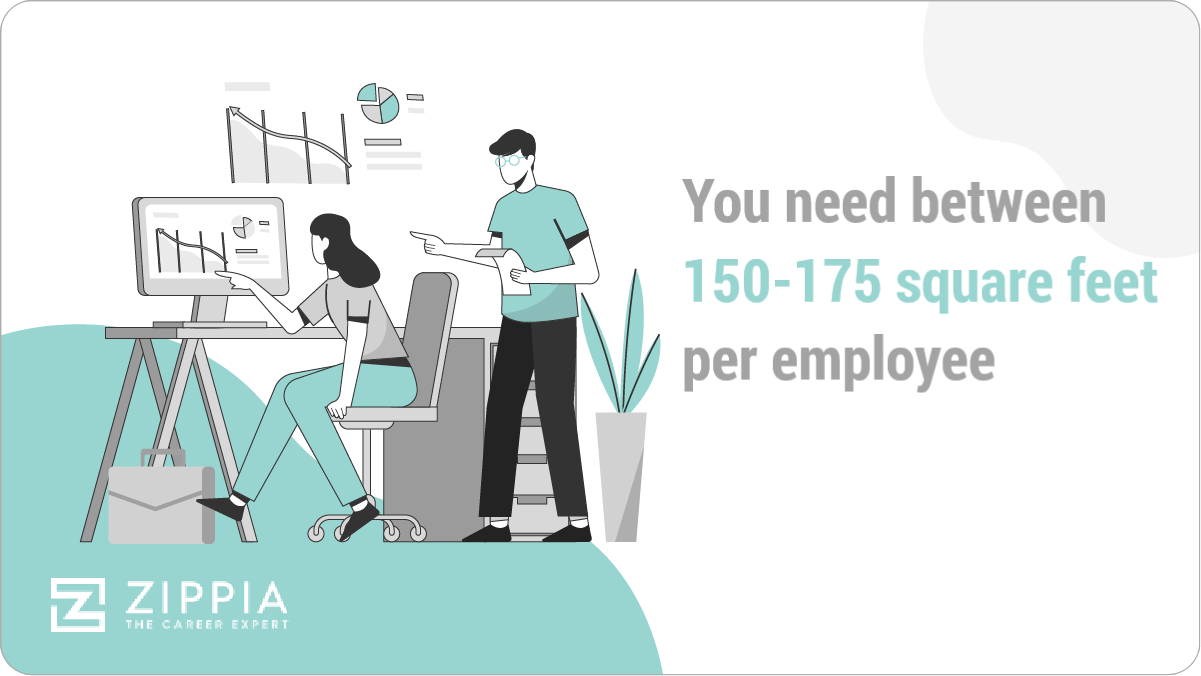
The average North American employee requires between 150 and 175 square feet of office space to work comfortably and effectively.
-
As a best practice, consider adding an additional 10-20% of office square footage to accommodate future growth.
-
Factors influencing the required office space per employee include density, geographic location, employee age, and cost per square foot.
-
Over the past decade, various factors have led to a 21% decline in average office space per employee, although recent trends indicate a rebound.
-
Consider including necessary common areas in your total square footage calculation, such as conference rooms, break rooms, quiet areas, and storage spaces.
For a more detailed analysis, we present the data in the following sections:
Office Space
How Much Office Space Per Employee: Key Statistics
The average office size per employee can vary based on various factors. Here are essential statistics regarding the amount of office space needed:
-
In North America, the average office space per employee is between 150 and 175 sq. ft.
This measurement includes personal Usable Square Footage (USF), which indicates how much space an employee needs to work comfortably and productively.
However, there is no one-size-fits-all number for USF, as it can be influenced by the specific company, industry, and type of work.
For instance, a call center employee may require about 120 square feet, while an employee in finance might need approximately 300 ft2. Other industry specifics include:
Average Office Space Needed by Industry
Industry Office Space Technology 115 to 155 ft2 Real Estate 210 ft2 Communications 257 ft2 Computer 265 ft2 Insurance 280 ft2 Architecture 275 ft2 Accountancy 265 ft2 Federal Government 312 ft2 Legal 411 ft2 Finance 110 to 245 ft2 Engineering 150 to 185 ft2 Law Enforcement 100 to 240 ft2 Social Services 175 to 235 ft2 Biotech and Science 125 to 410 ft2 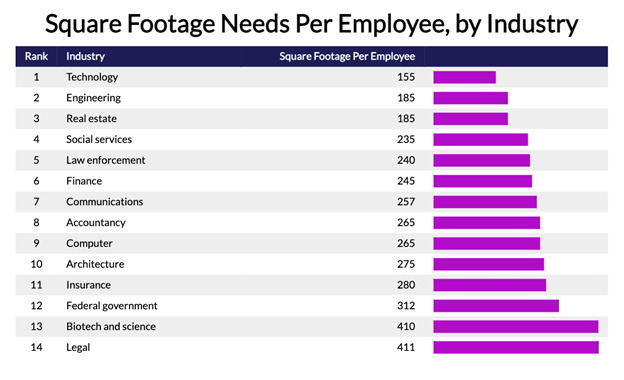
-
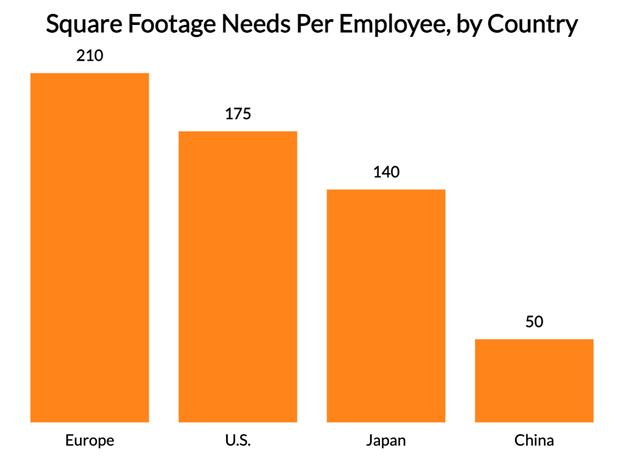
Your office’s geographic location can influence space requirements.
In Europe, the average space per employee is approximately 210 ft2, while in Japan it drops to 140 ft2 and to about 50 ft2 in China.
-
Office density also plays a critical role in determining space requirements.
-
High-density spaces (80 to 150 ft2 per employee) generally feature open seating arrangements with a few private offices, common in tech and coworking environments.
-
Average density (150 to 250 ft2 per employee) features a traditional office layout with a mix of desks, cubicles, and private offices.
-
Low-density (250 to 500 ft2 per employee) predominantly comprises large private offices.
-
-
Employee age can also impact space requirements.
Older workers may prioritize larger workspaces as a sign of success, while younger employees often seek different amenities in exchange for working in smaller areas.
-
The cost per square foot significantly affects how much office space you allocate per employee.
As with all commercial real estate, office space value largely depends on location. Average costs per square foot in various U.S. cities include:
Cost of Office Space by City
US City Cost of Office Space per Square Foot Atlanta $20.97 Boston $30.40 Chicago $35.00 Dallas $23.09 Washington, D.C. $52.61 Houston $28.34 Los Angeles $33.51 Miami $33.15 New York $74.00 San Francisco $65.16 Seattle $32.10 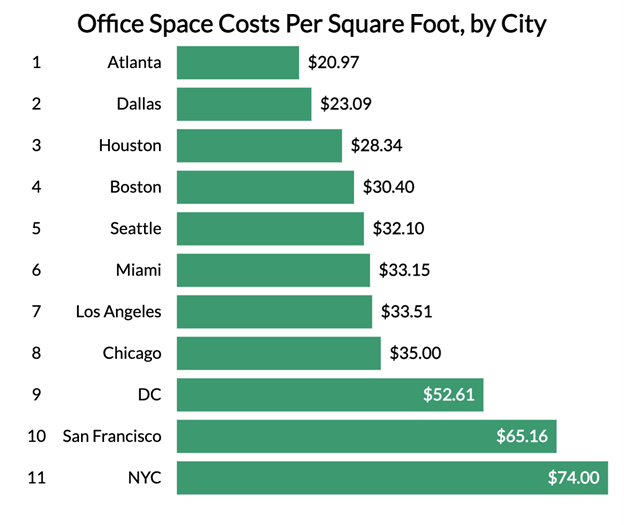
-
OSHA does not specify square footage requirements.
While OSHA does not mandate minimum requirements for office spaces, employees should be able to comfortably—and safely—enter and exit their work areas. A good rule of thumb is maintaining a minimum of three feet between desks and at least 50 square feet per employee.
-
The average office space per employee has seen fluctuations.
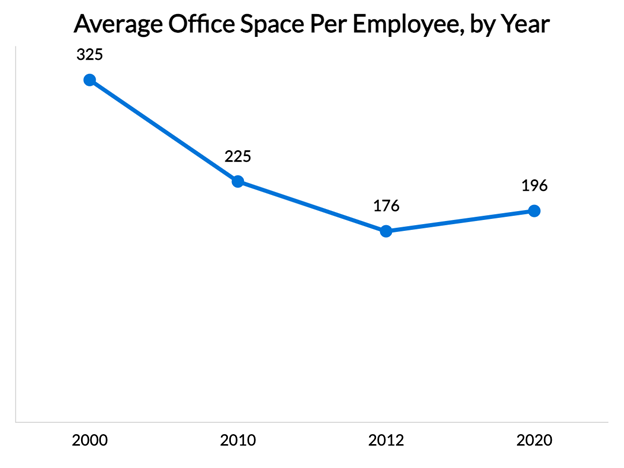
Recent trends in flexible workspaces and remote work have contributed to a decrease in average space per employee over the past decade, which fell by about 21%. The average amount of space per employee shifted from 225 ft2 to 176 ft2 between 2010 and 2012, with earlier figures as high as 325 ft2.
However, with an increasing focus on returning to in-office work while ensuring adequate physical distance, the average space per employee is now trending upwards.
-
While some executives predict a decrease in office space needs, many anticipate an increase.
About one-third of executives believe they will need less office space in the coming three years, while over half expect space requirements to increase. 26% of executives plan to increase their office space per employee by 5-15%, and 15% by up to 25%, with 9% considering over a 25% increase.
This shift is largely attributed to a growing necessity for dedicated desks and additional space in meeting rooms and communal areas.
-
Providing each employee with 113 ft2 of office space can facilitate adherence to six-foot separation guidelines.
Visualize this as a 12-foot diameter circle surrounding each employee within about 113 ft2. However, when factoring in shared spaces, implementing social distancing measures generally necessitates increasing average square footage per employee by nearly 50%.
In this context, the average office space per employee in 2020 rose to 196 ft2, reflecting more than a 20% increase compared to prior years.
-
Common area square footage is included in the total calculation of square feet per employee.
This means that if you average 200 ft2 per employee, a portion of this figure is allocated to shared spaces such as conference rooms and break areas.
This allocation also signifies that employees in larger private offices will occupy a larger share of available space compared to those in cubicles or workstations.
-
As a general principle, the denser the office, the larger percentage of space should be dedicated to common areas.
Common areas are not merely functional spaces; they reflect the company culture and brand, contributing to employee satisfaction and productivity. Depending on your goals, consider including kitchens, lounges, storage, wellness spaces, or libraries in your office layout.
-
Typically, you should have one conference room for every 10 to 20 employees.
Other communal space guidelines include:
Space Type Square Feet Open-area Workstations 60 to 110 ft2 per employee Workgroup Areas 80 to 100 ft2 per employee Reception 100 to 300 ft2, depending on waiting capacity Lunchroom/Break Room 75 ft2, plus 25 ft2 per seated person Quiet Room 10 to 100 ft2 for every 10 workstations Conference Room 25 to 30 ft2 per employee Library 175 to 450 ft2 Water Coolers/Drinking Fountains 1 unit per 75 employees Storage Room 50 to 200 ft2 File Room 200 ft2 Additionally, consider other common areas—often underutilized during daily tasks—such as lobbies, hallways, restrooms, and circulation spaces, which can contribute an extra 10% to 35% to overall office square footage.
Also, evaluate whether your business requires additional specialized spaces like server rooms, refrigerated areas, manufacturing facilities, or medical exam rooms.
-
Be sure to account for planned growth when calculating required office space per employee.
Consider your business growth plans over the coming years, including additional staffing and equipment needs. As a guideline, adding an extra 10-20% of office square footage for future growth is prudent. Since most leases last between two to five years, aim to project headcount to reach your occupancy limit around ⅔ or ¾ through your lease term.
Frequently Asked Questions: How Much Office Space Per Employee
-
How much office square footage do I need per employee?
To ensure comfort and productivity, each employee typically requires between 150-175 square feet of office space. However, there is no definitive formula to determine the exact square footage needed, as it varies by company, industry, and type of work.
Determining personal Usable Square Footage (USF) for your business can be insightful, as it quantifies how much space an employee needs to work comfortably and effectively.
-
What factors should you consider when deciding how much office square footage you need per employee?
Considerations include density (especially in light of current spacing guidelines), common areas (such as kitchens, break rooms, conference rooms, etc.), employee comfort, productivity, and more. These factors are crucial for ensuring employee safety and maximizing work efficiency.
-
Do some industries require more office square footage per employee than others?
Yes, certain industries, such as legal, insurance, architecture, and federal government, generally require more average square footage per employee compared to sectors like technology, real estate, finance, and engineering.
-
Add 10-20% additional square footage to your calculations to account for future growth, and aim to hit your occupancy limit around 2/3 or 3/4 through your lease term. This approach ensures you have sufficient space as your team expands.
-
How many square feet do you need for 100 employees?
For 100 employees, you will need between 15,000 and 17,500 square feet to ensure comfort and productivity. Experts recommend at least 150-175 square feet per office employee, resulting in a total of 15,000 to 17,500 square feet. To accommodate projected growth, consider aiming for 18,000 to 21,000 square feet.
-
What is the minimum size for an office?
The minimum size for an office is approximately 70 square feet. This allows for a basic workstation with a desk, phone, and computer, though such minimalism is generally suited for environments like call centers.
-
How is office space occupancy rate calculated?
Office space occupancy rate is calculated by dividing the occupied floor space by the total available floor space. This includes meeting rooms but excludes non-work areas like restrooms and pantries. For instance, in a 7,000 square foot office with 6,000 square feet currently occupied, the occupancy rate would be 85.7% (6,000/7,000).
Conclusion
While no single figure applies universally, most industries typically allocate between 150 and 300 square feet of space per employee, encompassing both work areas and shared spaces.
It’s important to remember that denser office layouts necessitate a larger portion of space dedicated to common areas. Don’t forget to plan for future growth to ensure your workspace evolves alongside your business!
References
-
Aquila Commercial. How Much Office Space Do I Need? Accessed on 8/30/21.
-
Robin. Moving to a New Office? Determine the Right Office Space Size. Accessed on 8/30/21.
-
iOffice. How Much Office Space Do We Need Per Employee? Accessed on 8/30/21.
-
OfficeFinder. How Much Office Space for This? How Much Office Space for That? Accessed on 8/30/21.
-
Houston Installation. How Much Office Space Do I Need? Accessed on 8/30/21.
-
SpaceIQ. What’s Average About Office Space Per Employee? Accessed on 8/30/21.
-
SquareFoot. How Much Office Space Per Employee Do You Need? Accessed on 8/31/21.
-
The Receptionist. How Much Office Space Do You Really Need? Accessed on 8/31/21.
-
CCIM Institute. How Much Space Do We Need? Accessed on 8/31/21.
-
LinkedIn. How much office space do I need? Accessed on 8/31/21.
-
Legal Beagle. OSHA Standards for Cubicles. Accessed on 8/31/21.
-
U.S. Fire Administration. Understanding the Impact of Social Distancing on Occupancy. Accessed on 8/31/21.
-
JLL. How will employee workspace needs change post-Coronavirus? Accessed on 8/31/21.
-
Expansive Workplace. How Much Should Startups Pay for Office Space? Accessed on 8/31/21.
-
The Balance Small Business. How Much Office Space Do You Need? Accessed on 8/31/21.
- HR Statistics
- Average Labor Cost Percent Of Sales
- Average Time to Reach Profitability At A Startup
- Office Space Per Employee
- Recruitment Statistics
- Employee Engagement Statistics
- Work-Life Balance Statistics
- BYOD Statistics
- Paternity Leave Statistics
- Onboarding Statistics
- Average Paid Maternity Leave In Us
- Average Cost Of A Bad Hire
- Employee Theft Statistics
- Paid Family Leave Statistics
- Cost Of Hiring Statistics
- Employee Turnover Statistics
- Average Cost Of Employer Sponsored Health Insurance Statistics
- Sexual Harassment In The Workplace Statistics
- HR Statistics
- PTO Statistics
- Social Media Recruitment Statistics
- Hiring Statistics
- Out Of Prison Employment Statistics

Author

Conor McMahon is a writer for Zippia, with previous experience in the nonprofit, customer service and technical support industries. He has a degree in Music Industry from Northeastern University and in his free time he plays guitar with his friends. Conor enjoys creative writing between his work doing professional content creation and technical documentation.