Explore jobs
Find specific jobs
Explore careers
Explore professions
Best companies
Explore companies
This question is about rental manager.
How to start a rental property business
To start a rental property business, you need to join a local real estate investor's club, select a niche and market, and determine your financing options. For details on these steps and others you can take to start a business in rental property, use this guide:
Join a local real estate investor's club. This is a crucial first step in terms of networking and getting connected in your local real estate market.
These clubs and associations present a great opportunity to get to know members that are involved in the type of business you want to start. You might even find a potential investor or partner through this avenue.
You are also likely able to get inside information and tips on your local rental property market. These insights from experienced professionals are invaluable to you, especially when you are just starting out.
There are several factors you should be seeking to identify before starting your rental property business, and joining a real estate investor's club or associate can assist you in this area. These types of meetups are typically geared toward helping new members, and at the very least, you get exposure to successful rental property owners.
Select a niche and market. Location is critical in all forms of real estate, and when it comes to finding appropriate houses, apartments, or condos to rent out, it is an absolutely essential factor to consider.
You need to think about many different factors when making this decision. First, what kind of rental property are you looking to purchase?
Houses can be the easiest because you simply need to get one person, couple, or family to fill the space. However, you do need to consider other factors, such as the proximity to good schools, food shopping, retail, and any other attractive features that have to do with location.
Much of this also holds true for apartments, and condos, however, these types of properties are likely to be in more densely populated areas where good amenities can be easily found.
You should also consider some of these essential questions:
How distant a market am I willing to invest in? Does it need to be close by, or can I handle a market that is farther away from my permanent location?
Do I have a team in place to handle the daily needs of my rental location, or will I have to commute back and forth?
How much will commuting and market research cost me in terms of time and money?
How stable and diverse is the economy in the markets I'm looking at? Are there various commercial sectors that can help keep jobs and businesses? Is there one main employer that rules the area?
What's the average market price for acquiring property in the area?
What's the average rental price of a house/apartment/condo in the area?
You do not have to live in the market you choose to invest in for your business property rental, although this can make things a lot easier.
Determine your financing options. Obtaining financing is perhaps the biggest challenge a prospective rental property owner can face.
However, you do have many options in this area. There is a myriad of lenders just waiting to give stellar real estate investors the funds they need to invest in real estate. Currently, real estate investors have more access to non-traditional means of financing than ever before.
You can always go with a conventional loan from an established bank, but you can also seek out private money lenders, and hard money lenders, to secure funding.
The one downside to working with these less traditional funding options is that they usually mean you will have higher interest payments, often around three to four times higher than traditional banks, however, the added cost can be well worth it.
When working with these funding options you typically get the money you need much faster than you do when going through established bank lenders. Banks can take months upon months to distribute your funds, whereas alternative lenders can have your money ready in a few days, or even in some cases, a few hours.
You should also be sure to secure your financing before you even begin to look at business-related properties and commercial spaces. This way you can determine what is realistically available to you once you do begin your search.
Hire a property manager. Becoming the owner of any type of property means you are going to be responsible for maintaining the property in certain ways.
Rental properties need to be kept up, in terms of maintenance, and appearance. Also, if you are buying a large apartment building, you are likely going to have many renters asking for certain things, in terms of maintenance and upkeep. If you handle this on your own, you are definitely going to be overwhelmed, even if you are handy.
Hiring a property manager means you put someone else in charge of these tasks. It relieves you of a lot of the stress and burdens that come with owning property. You also have the option of hiring a third-party property management company to take care of these needs.
Doing this enables you to expand your portfolio of business rental properties without having to do countless hours of work. Property managers can also help you find appropriate tenants, collect rent for you, and help you in many other valuable ways.
While they take care of the details you are then able to add more properties and assets to your portfolio and increase your passive income.
Develop a system. Once you are up and running, there are many ways to specialize your rental property business.
You can also choose to focus on high-income neighborhoods in urban areas, if your business allows. Different strategies require different skill sets, so you should try to formulate a strategy that works to your strengths, resources, and assets.
You are going to have to set up a system for running tenant applications, credit scores, and background checks, no matter what niche of the market your business finds itself in.
Securing a structured system is the only way to keep your business organized, while also enabling you to easily grow it. This means you must create a system for everything involved in renting out the property. This way you will always have a course of action, regardless of the different situations you encounter.
It's worth mentioning that property managers are a vital part of this equation, and help you to achieve stability in your rental property business.
Managing the properties. Hiring a property manager is not the only factor when it comes to managing your rental properties.
This is more of a reiteration that you need to have the proper systems in place and know the answers to some specific questions, such as:
Who is going to find and select tenants for my properties?
Am I going to be the sole landlord or am I going to hire a property manager?
Am I going to employ contractors to perform maintenance and repairs on my properties?
Who will perform other maintenance duties, such as those involving landscaping, pool, or gym?
The answers to these questions all depend on how much money your rental property business is starting out with, and of course the specifics of your properties. You should construct a rental property business plan that addresses all of these issues.
Your business plan should cover customer research, competitors, a startup budget, and financial projections for your painting business.
Other things you should add include issues you may need to solve for tenants, what sets your business apart from the competition, the resources your business will depend upon, and your businesses' mission statement and vision for the future of the company.
Your business plan is a critical document for yourself, especially if you are looking to get a small business loan or investors in your company.
Marketing your rental property business. Property managers and third-party companies often cover this, however, if you are choosing to start out without one of these elements, there are some marketing strategies you must consider.
Rental websites are a great resource for rental property owners. Here you can display your property along with pictures and descriptions of its features. You can also utilize social media to advertise and promote your rental properties.
Even old fashion ways of marketing work for rental property businesses. These include methods like ads in newspapers or print media, flyers on local bulletin boards at community centers or businesses, hiring local realtors, word-of-mouth marketing, direct mail ad campaigns, and utilizing previous renters of your properties.
Here are the features of successful rental properties:
Location. In real estate, it's always about location. This consideration needs to be top of mind, and it can not be stressed enough. Your location is going to determine many things, such as the type of tenants you are going to attract, and how much effort you will need to put into your own commuting to and from the property. Even if you hire a property manager or management company, you should still check in on your properties fairly regularly. You also need to consider the location in terms of the type of neighborhood, and how that could influence your tenant profile, their income, and how often you will have to deal with vacancies.
Schools. Having properties near highly-rated schools is a major plus. This attracts families, and families are often more reliable and trustworthy tenants. They also tend to rent for longer periods of time than single individuals or those seeking roommate situations. Families also tend to pay higher renter rates, meaning your properties can be more profitable overall.
Taxes. Depending on your location, you might have low or high property taxes to pay each year. Keep in mind though if you have property in an area with higher property taxes, this means you are going to attract higher-paying tenants to help offset this cost. It should be mentioned that your property taxes can be burdensome if your finances are not in order. You can contact your local assessor's office to find out your property tax rate.
Local jobs. A thriving local job market can help your properties pull in more gainfully employed tenants. Especially if you have a building or house that is in an area with a lot of high-paying jobs, such as in the tech sector. This could mean higher rental rates for your properties and fewer vacancies.
Amenities. Having ample resources for tenants to use that are close by is a great way to help boost your marketability. This holds especially true if you are purchasing properties in densely populated urban areas. In these cases, your houses or buildings should be within walking distance of some local shops, grocery stores, gyms, bars, restaurants, public transportation systems, entertainment and attractions, etc. If you are able to secure properties with a lot of these features close by, you are sure to be in no short supply of eager renters.
Safety. You should check the local crime statistics in the areas you are looking at to purchase properties in. This can come into play when determining what type of tenants will be available to you. For example, families are often not going to want to rent in areas where the crime rates are high.
Local economy. You can use stats on the area's local economy to gauge your rental property performance. Areas experiencing a lot of growth in local commerce, and in other ways, can be great rental property opportunities, however, you should also keep things like construction projects in mind. While the expansion of the economy in an area can be a great feature for your property, construction projects can be quite noisy and may last a long amount of time.
Rental rates. You should do this during your market research phase. You need to find out what the average rental rates are in your property's area to consider your pricing options. Also, you should be sure to factor in other costs including mortgage payments, maintenance and repair costs, and property taxes.
Vacancies. Do a good amount of research on the vacancy rates in the areas you are looking to buy properties. If they are high, this might be an indication of a bad area for investment. Depending on the specifics of an area, you may not want to purchase properties that are in a community experiencing any sort of decline.
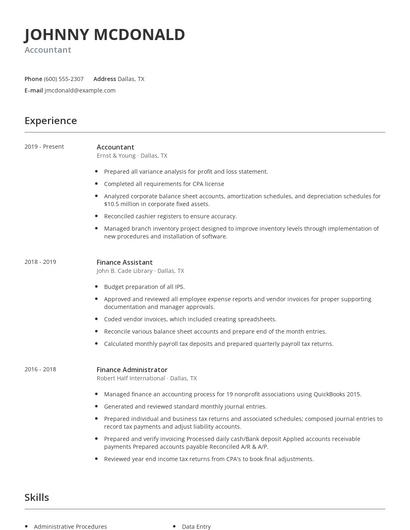
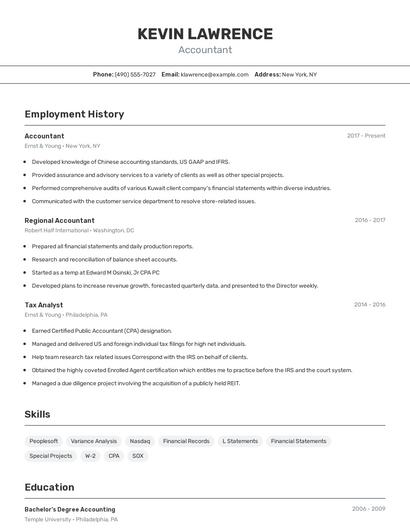
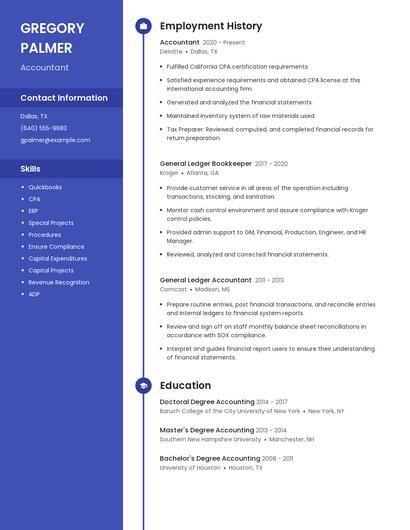
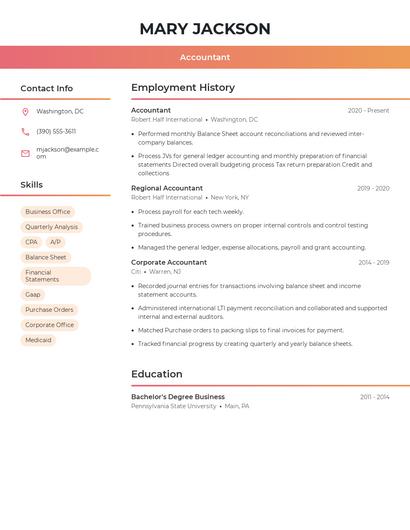
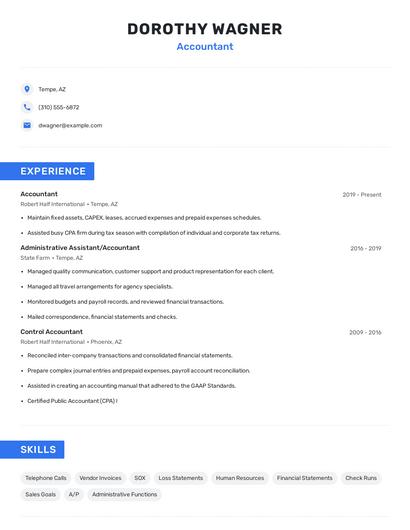
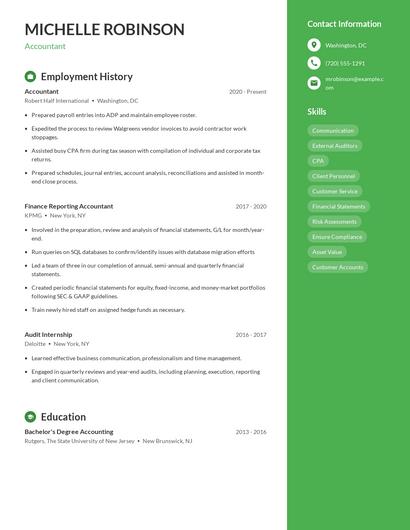
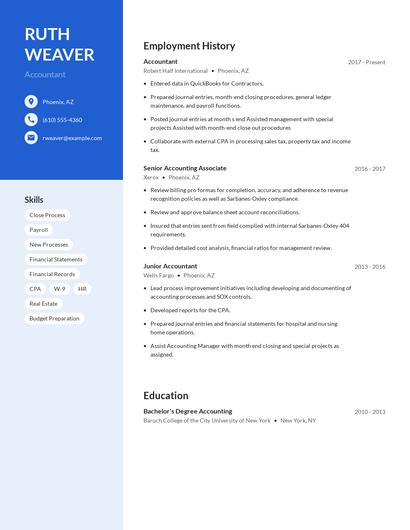
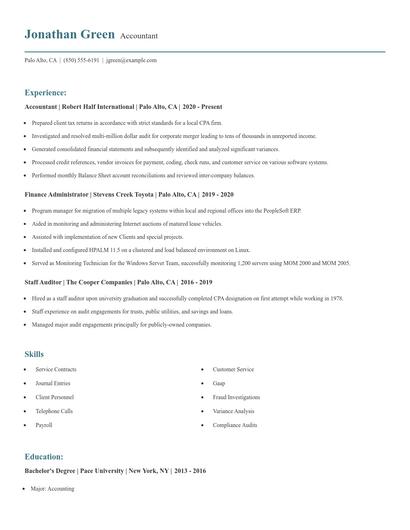
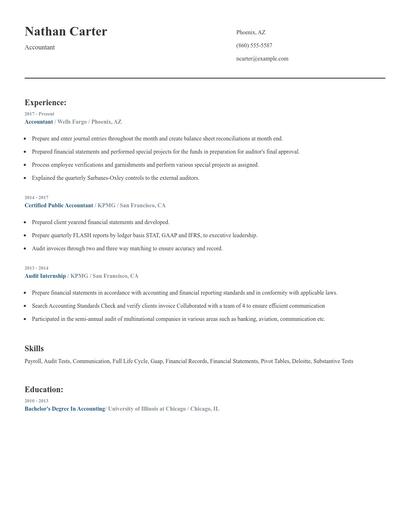
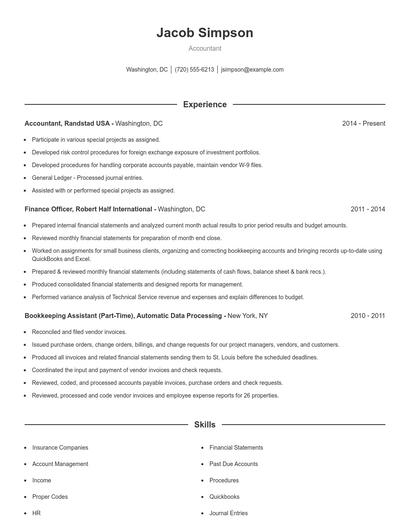
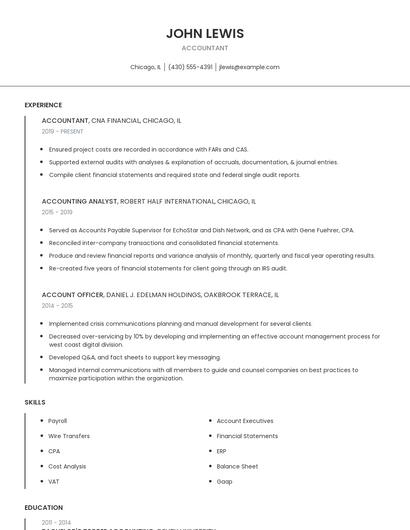
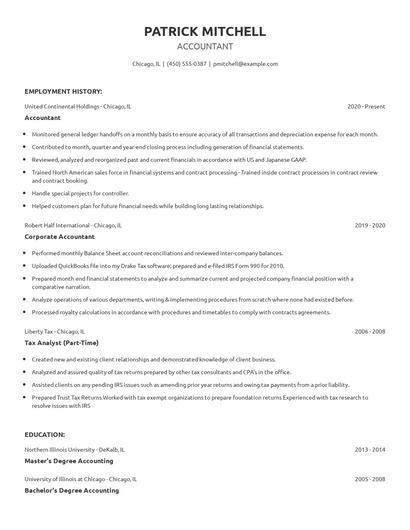
Choose from 10+ customizable resume templates
Zippia allows you to choose from different easy-to-use templates, and provides you with expert advice. Using the templates, you can rest assured that the structure and format of your resume is top notch. Choose a template with the colors, fonts & text sizes that are appropriate for your industry.